Digital Marketing
Checklist for Advanced Meta Ads Campaigns
Simplicity and disciplined testing beat micro-targeting: a step-by-step checklist to set up Meta Ads, fix tracking, test creatives, and scale campaigns.
Meta Ads in 2025 require a new approach. Forget micro-targeting and constant adjustments - success now relies on simplicity, clear objectives, and disciplined testing. Here's a quick guide to mastering advanced campaigns:
Set up your foundation: Configure Business Manager, verify domains, and enable dual tracking with Meta Pixel and Conversions API.
Focus on funnel-based campaigns: Segment audiences into Prospecting (cold), Retargeting (warm), and Loyalty (existing customers) stages.
Test creative elements systematically: Experiment with hooks, formats, headlines, and CTAs to identify top performers.
Monitor key metrics: Track ROAS, CPA, CTR, and frequency daily, and adjust based on trends.
Scale strategically: Use vertical scaling (gradual budget increases) or horizontal scaling (new audiences or creatives) while avoiding big changes all at once.
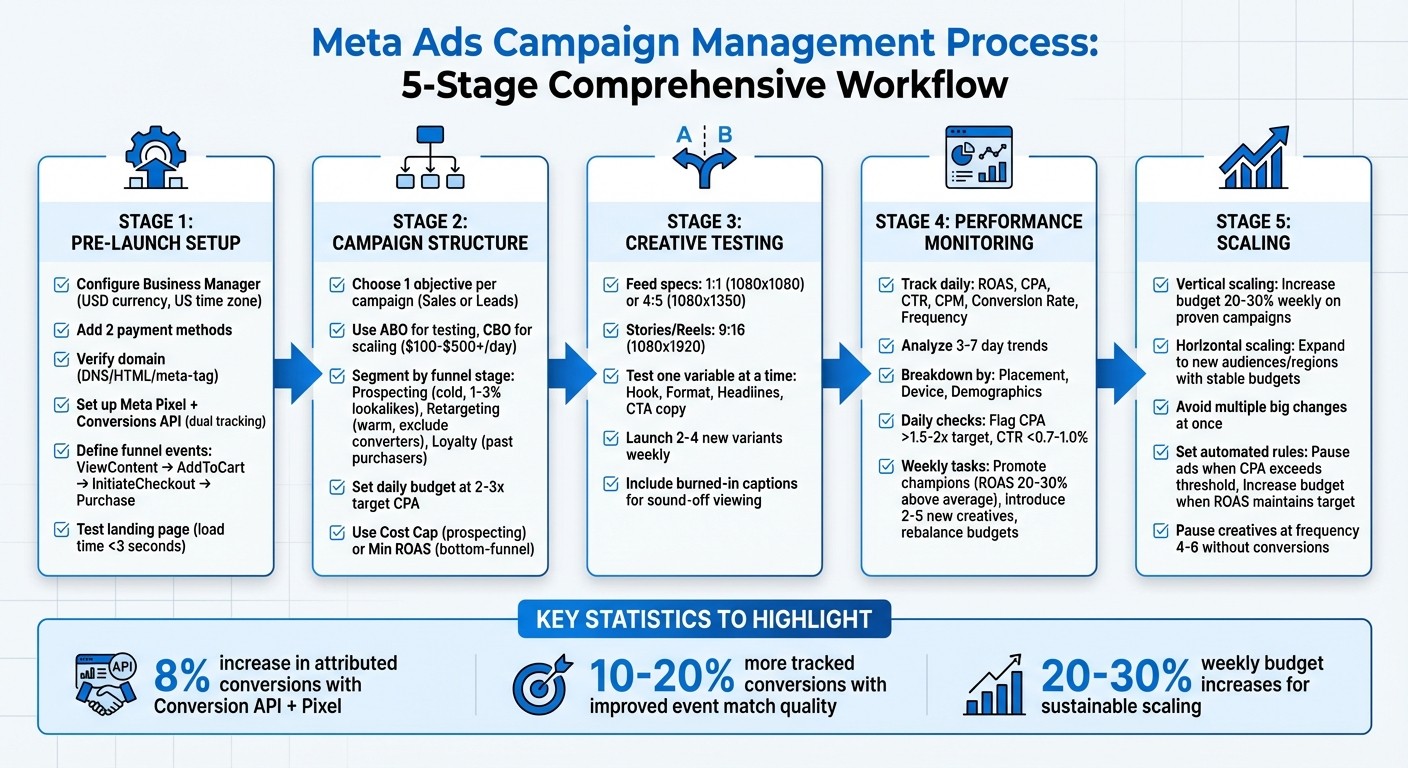
Meta Ads Campaign Setup and Optimization Process: 5-Stage Framework
Pre-Launch Setup
Before diving into Meta Ads, it's crucial to establish a strong technical foundation. This ensures accurate tracking, avoids wasted ad spend, and sets the stage for effective campaign optimization. Here’s how to get everything in order before launching.
Business Manager and Account Configuration
Start by reviewing your Business Manager settings in Meta Business Suite. Double-check that your business details - like legal name and U.S. address - are correct. Set your ad account to use USD currency and choose a U.S. time zone (Eastern or Pacific) to align with performance reporting.
To avoid interruptions, add two payment methods (a primary and a backup credit card). Set account spending limits that align with your daily budget, but don’t restrict them so tightly that your campaigns stall. Assign role-based access (Admin, Advertiser, Analyst) and enable two-factor authentication for all administrators. If you’re working with an agency, such as Dancing Chicken, grant them Partner access so they can manage campaigns while you retain control over the account.
For advanced campaigns, domain verification is a must. Go to Business Settings under Brand Safety and verify your domain using one of three methods: DNS TXT record, HTML file upload, or meta-tag. Once verified, you’ll be able to configure priority events for Aggregated Event Measurement, which is essential for optimizing conversions in today’s privacy-conscious environment. If your funnel includes subdomains (like "checkout.example.com"), ensure they’re covered under your root domain verification.
Tracking and Event Setup
Set up both Meta Pixel for browser-based tracking and the Conversions API for server-side tracking. This dual approach helps you bypass ad blockers and capture more complete data. Use native integrations (e.g., Shopify, WooCommerce) or tools like Google Tag Manager for custom setups.
Define your key funnel events with standard names, such as:
E-commerce: ViewContent, AddToCart, InitiateCheckout, Purchase
Lead generation: Lead, CompleteRegistration
Make sure to include accurate USD values and parameters for these events to calculate ROAS properly. Use the Test Events tool in Meta’s Events Manager to verify everything is working. Perform test conversions to ensure both Pixel and Conversions API events match with the same event IDs - this step is critical for deduplication. In Aggregated Event Measurement, prioritize up to eight events per domain based on their importance to your business. For example, e-commerce businesses might prioritize Purchase, InitiateCheckout, AddToCart, and ViewContent.
Offer and Funnel Review
Once tracking is set up, shift your attention to the user journey. Start by testing your landing page to ensure it loads in under three seconds and displays properly across mobile and desktop on major U.S. browsers. Make sure that key elements - like your headline, pricing (formatted as $X.XX), and call-to-action - are consistent between your ads and landing page. Misalignment here can lead to lower conversions and higher CPAs.
Go through every step of your funnel, including form submissions, checkout flows, payment processing, and confirmation pages. Confirm that tracking events fire correctly at each stage and that UTM parameters remain intact through any redirects. Add trust-building elements, such as money-back guarantees, customer reviews, and privacy policies, which are especially important for U.S. audiences. Lastly, ensure your offer complies with Meta’s ad policies and FTC guidelines, particularly regarding discounts, testimonials, and earnings claims.
Set up custom columns in Ads Manager to monitor key performance metrics like CPM, CTR, CPC, CPA, and ROAS from day one. Use consistent UTM parameters across all ads to enable reliable analysis in tools like Google Analytics or your CRM. For more complex funnels, tools like Hyros or TripleWhale can provide advanced tracking and attribution capabilities.
Campaign and Ad Set Structure
Once you've got the technical setup nailed down, it's time to organize your campaigns in a way that boosts algorithm learning and gives you clear insights into performance. A well-structured account not only helps Meta's algorithm work more efficiently but also makes it easier for you to spot what’s driving results - and what isn’t.
Campaign Objectives and Budget Settings
Stick to one objective per campaign - either Sales (for purchases or high-intent conversions) or Leads (for sign-ups). Mixing objectives can confuse the algorithm, so keeping it focused sharpens optimization. For an e-commerce store, go with the Sales objective and optimize for the Purchase event. If you're aiming for webinar sign-ups, use the Leads objective optimized for the Lead event.
During testing, Ad Set Budget Optimization (ABO) is your best friend. It allows for strict control over spending, ensuring you can test without overspending. Once you’ve identified the ad sets that are performing well, switch to Campaign Budget Optimization (CBO). This lets Meta allocate more of your budget to the ad sets delivering the best results. For scaling, aim for CBO budgets in the range of $100–$500+ per day, and increase budgets by 20–30% weekly as long as performance remains steady.
From there, focus on audience targeting, ensuring it aligns with each stage of your funnel.
Audience Segmentation by Stage
Organize your campaigns according to funnel stages: Prospecting (cold audiences), Retargeting (warm audiences), and Loyalty (existing customers). Each stage should have its own campaign or clearly defined ad sets. This avoids audience overlap and ensures reporting stays clean.
Prospecting: Target cold audiences using 1–3% lookalike audiences built from high-value customers or broad interest-based targeting.
Retargeting: Focus on users who have already engaged with your brand, such as website visitors, cart abandoners, or video viewers. Be sure to exclude converters from these audiences to maintain clarity and prevent overlap.
Loyalty: Use custom audiences of past purchasers or high-value customers to run cross-sell, upsell, or reactivation campaigns. To avoid wasting ad spend, exclude past purchasers from prospecting campaigns.
Bidding and Pacing Settings
Once your audiences are segmented, choose a bid strategy that aligns with your goals. For Prospecting and upper-funnel retargeting, go with Cost Cap to maintain a predictable CPA. For bottom-funnel campaigns, where revenue efficiency matters most, opt for Min ROAS. For instance, you might set a Cost Cap of $50 for a prospecting campaign targeting a 1% lookalike audience or a Min ROAS of 3.0x for a cart abandoner campaign.
To help the algorithm exit the learning phase efficiently, set daily budgets at 2–3x your target CPA during testing. This provides enough data without exposing you to unnecessary risk. Stick with Standard delivery for most campaigns - it spreads your budget evenly throughout the day, which is ideal for testing and maintaining steady performance. Use Accelerated delivery only for time-sensitive promotions where you need to spend the budget quickly.
Creative Testing and Refresh Process
Once you've set up your campaign structure and audience targeting, the next step is optimizing your creative assets. Why? Because your creatives are the driving force behind engagement and conversions. They determine whether someone pauses to check out your ad or simply scrolls past. To keep performance strong, advanced campaigns need a structured system for testing, updating, and scaling creative assets. This ensures your ads stay engaging while keeping costs manageable.
Creative Specifications by Placement
Your creatives need to fit the right specs for each placement. For Feed placements on Facebook and Instagram, stick to 1:1 (1,080 x 1,080 pixels) or 4:5 (1,080 x 1,350 pixels) formats. These dimensions are ideal for mobile users, who make up the majority of the audience. Make sure your key details - like text, pricing, and branding - stay within the safe zones to prevent cropping.
For Stories and Reels, go with a 9:16 vertical format (1,080 x 1,920 pixels). Full-screen visuals work best here, but be mindful of Meta's interface elements at the top and bottom. Keep logos, text, and calls-to-action (CTAs) away from these areas. And since many U.S. users watch without sound, include burned-in captions and bold text to ensure your message gets across, even in silence.
Once your assets are formatted correctly, you can start experimenting with creative elements to refine performance.
Testing Variables in Ads
With the proper specs in place, focus on testing creative elements systematically. Every campaign should have one clear learning goal, and you should test just one variable at a time - whether it’s the hook, format, headline, or CTA. This approach keeps your results straightforward and actionable.
Here are some key variables to test:
The hook: Experiment with the first three seconds of a video to grab attention.
Creative format: Compare static images, carousels, and videos to see what resonates.
Headline and text angle: Test emotional, rational, or urgency-driven messaging.
CTA copy: Try options like "Shop Now", "Get Offer", or "Book a Call."
Always compare new ideas against your best-performing creative, also known as your "champion." If a new variant doesn’t outperform the champion, it’s not worth scaling.
Meta’s A/B Testing tool is great for clean comparisons, or you can use dynamic creative setups to test multiple combinations of headlines, formats, and CTAs at once. This method helps you spot patterns in what works, rather than just identifying one-off successes.
Rotating and Scaling Top Performers
When ad frequency climbs, click-through rates (CTR) drop, and cost per acquisition (CPA) rises, it's time to rotate in fresh creatives. For campaigns with medium to high budgets, aim to introduce 2–4 new creative variants every week or two for each key ad set.
Once a creative starts outperforming your account averages for CPA or return on ad spend (ROAS) and delivers consistent conversions, it’s ready to scale. Increase the budget for that ad by 20–30% weekly, and expand its reach to broader U.S. audiences, like lookalike groups or Advantage+ placements. Make sure to activate additional placements where the creative format fits seamlessly.
To stay efficient, monitor metrics like CTR and CPA closely. Use automated rules to pause creatives when CPA exceeds your target or when frequency hits 4–6 in prospecting campaigns without delivering conversions. This approach keeps your campaigns focused on what works, eliminating wasted spend on underperforming ads.
Performance Monitoring and Scaling
Once your creatives start delivering results, the next step is maintaining and boosting performance. This requires keeping a close eye on key metrics and scaling campaigns wisely. A well-structured approach ensures you avoid wasting money or missing growth opportunities.
Tracking Metrics and Identifying Issues
With creative testing in place, shift your focus to performance monitoring. This step builds on your earlier tracking setup and creative tests, ensuring your campaigns stay on track.
Start by creating a custom report in Meta Ads Manager. Include the metrics that matter most: ROAS, CPA, CTR, CPM, Conversion Rate, and Frequency. These metrics are the backbone of any advanced campaign. Check them daily, but also analyze trends over 3–7 days to smooth out short-term fluctuations. This is especially important in the post-iOS 14 era, where data variability can complicate decision-making.
Use breakdowns to dig deeper into your data. Segment results by Placement (e.g., Feed, Stories, Reels), Device (iOS vs. Android), and Demographics (age, gender, location). This helps you identify where your budget is working and where it’s being wasted. For example, if Instagram Reels delivers a 4.0 ROAS while Audience Network lags at 0.8, redirect your budget accordingly. Similarly, if Android users outperform iOS users in CPA, adjust your bids or tailor creatives for each platform.
When performance dips, follow a step-by-step diagnostic process. Start by checking Events Manager for issues with pixel or API tracking. If conversions drop but CTR remains steady, tracking errors could be the cause. If CTR declines while frequency rises (above 3–4 for prospecting), it’s likely your creative has hit fatigue. On the other hand, if CTR is steady but conversion rates fall, the issue may lie with your landing page or offer. A rise in CPM with stable CTR and conversion rates suggests increased competition - not necessarily a problem with your campaign.
Daily and Weekly Optimization Tasks
Daily checks should be light and focused on spotting major issues without disrupting the learning phase. Monitor spend versus budget caps and flag any anomalies. For instance, if CPA exceeds 1.5–2x your target for three consecutive days with at least 3–5 conversions, it’s time to pause or scale back. Similarly, if ROAS drops below breakeven for three days with 10+ conversions, consider reducing spend or pausing the campaign. Keep an eye on CTR - anything below 0.7–1.0% combined with rising frequency signals it’s time to refresh your creatives.
Weekly tasks are more strategic. This is when you make structural adjustments and reallocate budgets. Focus on promoting “champion” creatives - those that deliver ROAS 20–30% above average or CPA 20–30% below average with at least 20 conversions. Phase out underperformers and introduce 2–5 new creative variations each week to keep your testing pipeline active and combat creative fatigue. Evaluate your bid strategies: if campaigns are under-delivering despite strong metrics, consider loosening cost caps or experimenting with highest-value bidding. Rebalance budgets across the funnel. For instance, if remarketing campaigns are capped but delivering a 5+ ROAS, increasing their budget modestly makes sense.
Once performance stabilizes, you’re ready to scale.
Scaling Methods
Scaling successful campaigns can be done in two ways: vertically or horizontally.
Vertical scaling involves increasing the budget on proven campaigns by 20–30% weekly. This gradual approach ensures you don’t disrupt the learning phase.
Horizontal scaling is about expanding to new audiences or regions while keeping the budget stable on existing winners. This method spreads risk and avoids hitting diminishing returns on a single campaign. For example, you can clone a winning campaign and target new U.S. regions, different lookalike audiences, or value-based lookalikes. You can also test new creative angles - such as user-generated content, testimonials, or comparison ads - within your top-performing campaigns. Although slower, this approach is more sustainable, especially when entering new markets.
Whatever scaling method you choose, avoid making multiple big changes at once. Adjust one major factor - like budget, targeting, or creative - at a time, and evaluate the impact before moving forward. Use automated rules to keep things on track. For example, set rules to pause ads when CPA exceeds your threshold after a minimum spend or to increase budgets on campaigns maintaining ROAS above your target. This systematic approach helps you grow without compromising performance.
How Dancing Chicken Supports Advanced Campaigns
When to Work with Dancing Chicken
Dancing Chicken partners with U.S. businesses that have established products and spend at least $10,000 monthly on Meta Ads, particularly those utilizing multi-step funnels. If your campaigns involve flows like lead magnet → webinar → sales call or UGC → quiz → product bundle, and you're struggling with tracking and attribution beyond Meta's native tools, it might be time to seek expert help. This is especially true for growth-stage e-commerce brands, SaaS companies, or providers of high-ticket services with strong customer lifetime value but limited in-house expertise in performance media, creative strategy, and analytics.
Key indicators that you may need outside support include difficulty scaling ad spend by 20–30% monthly while maintaining ROAS, inconsistent results despite frequent adjustments, and relying on intuition rather than structured testing. Other red flags include messy campaign setups with no clear creative testing protocols, unreliable data caused by poorly configured pixels or Conversions API, and challenges in identifying which campaigns drive incremental revenue when managing multiple offers or regions.
Dancing Chicken steps in with tailored solutions to address these challenges and streamline advanced campaign management.
Services Offered by Dancing Chicken
Dancing Chicken begins with a free ad account and funnel audit, offering a comprehensive analysis of your campaign structure by funnel stage. This audit pinpoints gaps in tracking, audience segmentation, and bidding logic, while delivering a prioritized roadmap to improve ROAS. The process includes a deep dive into historical performance, audience overlap, creative performance by format and messaging, budget strategies, and tracking setup (e.g., event prioritization and UTM taxonomy). Recommendations may include consolidating campaigns, redefining conversion events, reallocating budgets by funnel stage, and launching targeted creative tests to minimize disruptions during the learning phase.
From there, the team develops customized campaign strategies for complex funnels and high ad spend. Campaigns are organized by intent tiers and lifecycle stages - cold awareness, warm consideration, and hot conversion/retargeting - rather than just interests or demographics. For each stage, they craft specific offer stacks and messaging: educational content and UGC for cold audiences, social proof and comparison ads for warm leads, and urgency-driven bundles for hot prospects. Budget allocation aligns with funnel performance, LTV, and margins, with proven campaigns receiving increased investment while test campaigns remain in controlled learning environments.
A standout feature is Dancing Chicken's bi-weekly creative refresh cycle, which ensures campaigns remain dynamic and effective. The team produces 8–20 new creative variants every two weeks, tailored to relevant placements and guided by multivariate testing frameworks. Each test isolates a single variable to optimize learning, benchmarking against a "champion" creative. New creatives are rotated weekly or bi-weekly to prevent ad fatigue without destabilizing performance. Clear rules, such as pausing creatives with CPAs exceeding 30% of the target after a specific spend threshold, ensure data-driven decisions.
Dancing Chicken also builds centralized dashboards to simplify performance tracking. These dashboards integrate data from Meta and other platforms like CRMs and analytics tools, providing a clear view of funnel performance, cohort insights, and cross-channel impact. Metrics such as spend, revenue, ROAS, CPA, click and conversion rates, and creative-level performance are segmented by funnel stage, device, and placement. Daily views highlight immediate issues, while weekly and monthly reports focus on broader strategic decisions like budget shifts and scaling opportunities.
Beyond campaign execution, the team analyzes offer performance by audience and funnel stage, identifying which lead magnets, tripwires, bundles, and upsell flows consistently hit target ROAS and CPA. Insights from click behavior, view-through performance, and CRM or sales data are used to refine these offers for better results.
Communication is structured to ensure seamless collaboration. Weekly calls focus on performance reviews, active tests, and next steps, while monthly strategy sessions explore scaling opportunities, new offer ideas, and cross-channel insights. Dedicated Slack channels enable quick feedback on creative approvals, urgent account issues, and day-to-day updates. This integrated approach keeps creative production, campaign adjustments, and funnel experiments aligned with overarching marketing and sales goals, driving more cohesive and scalable Meta Ads campaigns.
Conclusion
Running successful Meta Ads campaigns requires a structured, step-by-step approach. From setting up Business Manager and ensuring accurate Pixel and Conversion API tracking to building clear funnels and systematically testing creatives, every step plays a role in achieving scalable results. Meta has reported that advertisers using the Conversion API alongside the Pixel experienced an average 8% increase in attributed conversions [2], underscoring how critical technical fundamentals are to your success.
By relying on a solid setup and a clear testing framework, you eliminate guesswork and make decisions rooted in data. Segmenting your audience into awareness, consideration, and conversion stages, while testing creative elements and scaling budgets incrementally (20–30% weekly), lays the groundwork for consistent performance. According to industry data, improving event match quality through better tracking can increase tracked conversions by 10–20% [1][2], all while stabilizing your cost per acquisition.
Sustained success with Meta Ads isn’t about a one-and-done setup - it’s about ongoing refinement. Regular creative updates and performance reviews help prevent ad fatigue and uncover new opportunities before they become costly issues. Brands that consistently excel treat Meta Ads as a dynamic channel, prioritizing continuous optimization over a "set it and forget it" mentality.
For businesses with complex funnels or monthly ad spends exceeding $10,000, bringing in external expertise can take results to the next level. Agencies like Dancing Chicken offer free ad account audits, customized strategies, bi-weekly creative updates, and centralized dashboards tailored to U.S. businesses. Their team handles tracking, funnel optimization, and creative testing, so you can focus on scaling your business.
Start by implementing the checklist outlined here, track your progress, and refine your approach based on the data. Whether managing campaigns internally or partnering with experts, building strong foundations, committing to rigorous testing, and consistently optimizing will pave the way for scalable growth with Meta Ads.
FAQs
Why should I use both Meta Pixel and Conversions API for tracking?
Using Meta Pixel alongside the Conversions API enhances tracking precision by capturing user activity across various devices and platforms. This dual approach helps combat data loss caused by browser restrictions, like cookie limitations, ensuring more dependable conversion data.
With more accurate tracking in place, you can fine-tune your campaigns for better results, ultimately driving stronger performance and a higher return on investment.
How do I prioritize events for Aggregated Event Measurement in Meta Ads?
To make the most of Meta's Aggregated Event Measurement, start by focusing on events that directly support your main business objectives. Begin with your most valuable conversions, like purchases or lead submissions, and assign them the highest priority. For instance, label these as "priority 1" to ensure they're optimized for users on iOS 14.5+ and Android devices.
Once you've set up your top-priority events, move on to secondary actions, such as add-to-cart or page views, which play a role in supporting your overall marketing goals. This strategy helps you stay focused on driving revenue while also keeping your campaigns effective and aligned with your broader objectives.
How can you tell when it’s time to update your ad creatives?
If you’re seeing a dip in key metrics like click-through rate (CTR), conversion rate, or return on ad spend (ROAS), it might be time to rethink your ad creatives. Another red flag is audience fatigue - this often shows up as increased ad frequency but lower engagement. And if your messaging or visuals just aren’t sparking interest anymore, it’s a clear sign that your creative might have run its course.
Related Blog Posts
Checklist for Troubleshooting Meta Ads
Best Practices for Pre-Launch Ad Testing
Common Meta Ads Metrics Mistakes and Fixes
Checklist for High-Performing Meta Ad Creatives