Digital Marketing
Meta Ads API Deprecation Notices: What to Know
Meta Ads API deprecations change reporting, limit historical data, remove metrics, and alter targeting—export old data, enable CAPI, and switch to Advantage+.

Meta's Ads API updates are shaking up how advertisers manage campaigns. Here's what you need to know:
Key Changes: Starting January 12, 2026, historical data for certain metrics is limited to 13 months (unique counts) and 6 months (frequency breakdowns). Meta also removed 7-day and 28-day view-through attribution windows, leaving shorter options like 1-day view.
Targeting Updates: As of January 15, 2026, campaigns using old detailed targeting interests will no longer run. Advertisers must switch to broader groupings or the AI-driven Advantage+ Audience approach.
Metrics Removed: Over 100 metrics, including
unique_actions, were phased out. Reporting workflows now focus on simpler metrics like total actions or "First Conversion" reporting.Video Metrics: The 10-second video view metric was retired on January 26, 2026. Advertisers should now track ThruPlay or 2-second continuous views.
Offline Tracking: The Offline Conversions API was replaced by Conversions API (CAPI) in May 2025, providing unified tracking for online and offline events.
Action Steps:
Audit and update your campaigns for deprecated fields and metrics.
Transition to Advantage+ features for targeting, budget, and placement.
Export older data before it’s lost due to retention limits.
Use tools like CAPI for accurate tracking and better results.
These updates require immediate attention to avoid disruptions in reporting and campaign performance.
Recent Meta Ads API Deprecation Notices
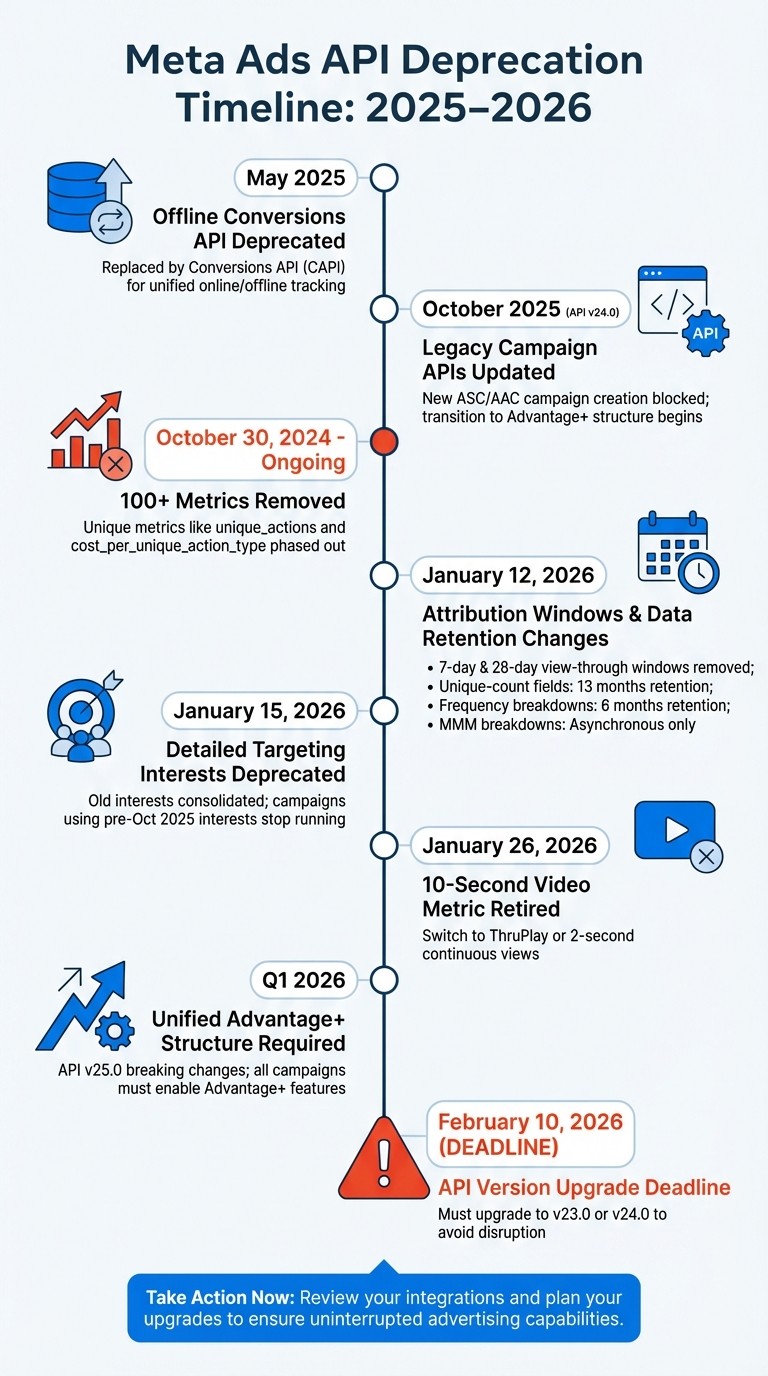
Meta Ads API Deprecation Timeline 2025-2026
Meta has announced several API deprecations scheduled between late 2025 and early 2026, affecting how advertisers manage campaigns. Here’s a breakdown of the major updates and their timelines.
Detailed Targeting Interests Deprecation (January 2026)
Starting January 15, 2026, Meta stopped delivering campaigns using detailed targeting interests created before October 8, 2025. These interests have been consolidated into broader groupings, encouraging advertisers to shift toward the AI-driven Advantage+ Audience approach [8][9].
Legacy Advantage Shopping and App Campaign APIs Deprecation (Q1 2026)
In Q1 2026, Meta introduced a unified structure to replace the older Advantage Shopping Campaign (ASC) and Advantage App Campaign (AAC) APIs [10].
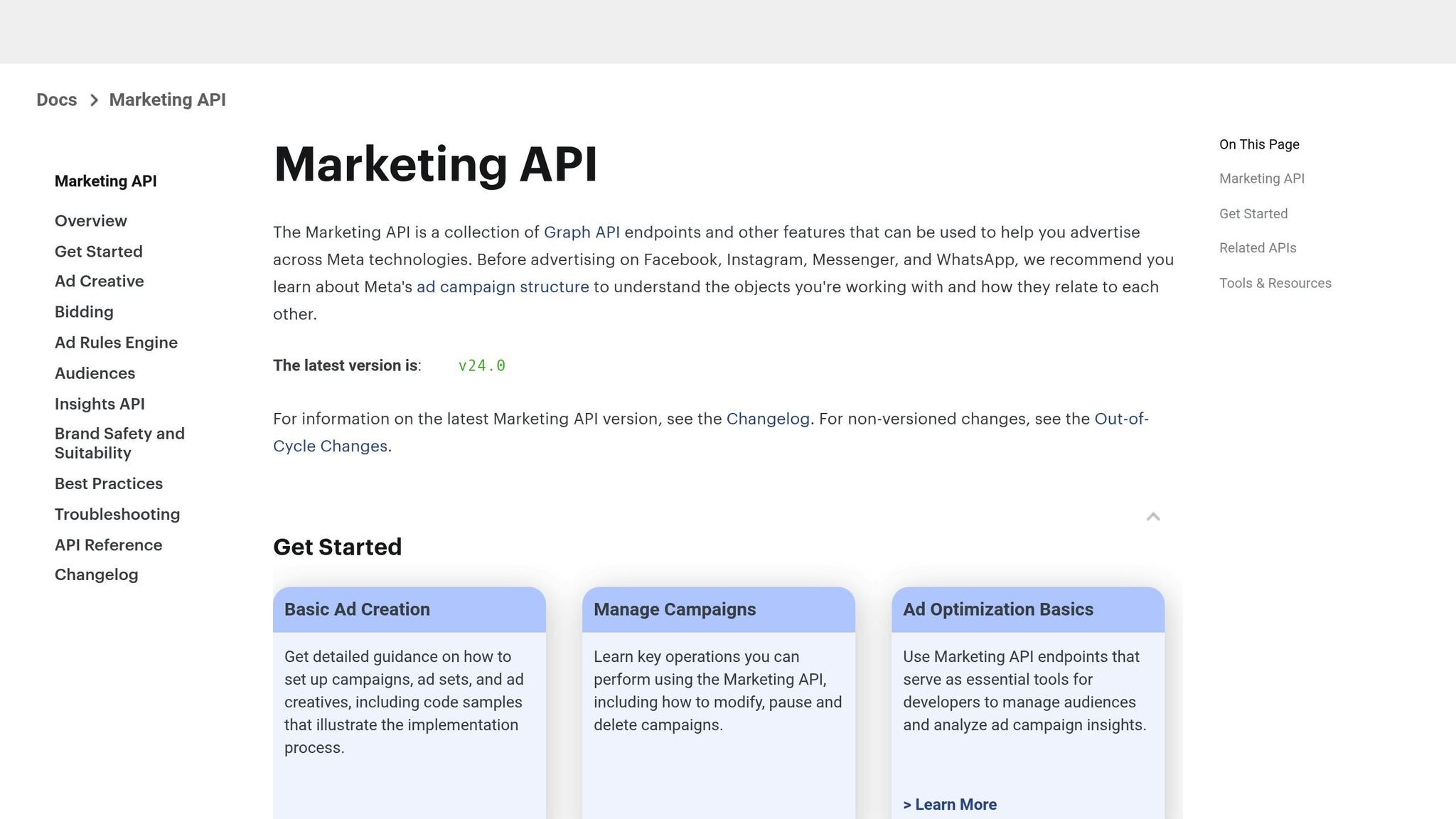
Marketing API Version 24.0 (released October 2025) prevented the creation of new ASC/AAC campaigns.
Version 25.0 brought breaking changes across all versions, requiring campaigns to enable Advantage+ features for budget, audience, and placement management.
Additionally, the removal of the existing_customer_budget_percentage field means advertisers now need separate ad sets for existing and new customers. The migrate_to_advantage_plus field allows campaigns to transition to the new API structure while keeping their original campaign IDs intact [10].
10-Second Video Metrics Deprecation (January 26, 2026)
As of January 26, 2026, Meta retired the 10-second video view metric, a key measure for evaluating video performance. Advertisers now need to adjust their reporting workflows to focus on ThruPlay (which tracks full or 15+ second views) or 2-second continuous views.
Offline Conversions API Deprecation (May 2025)
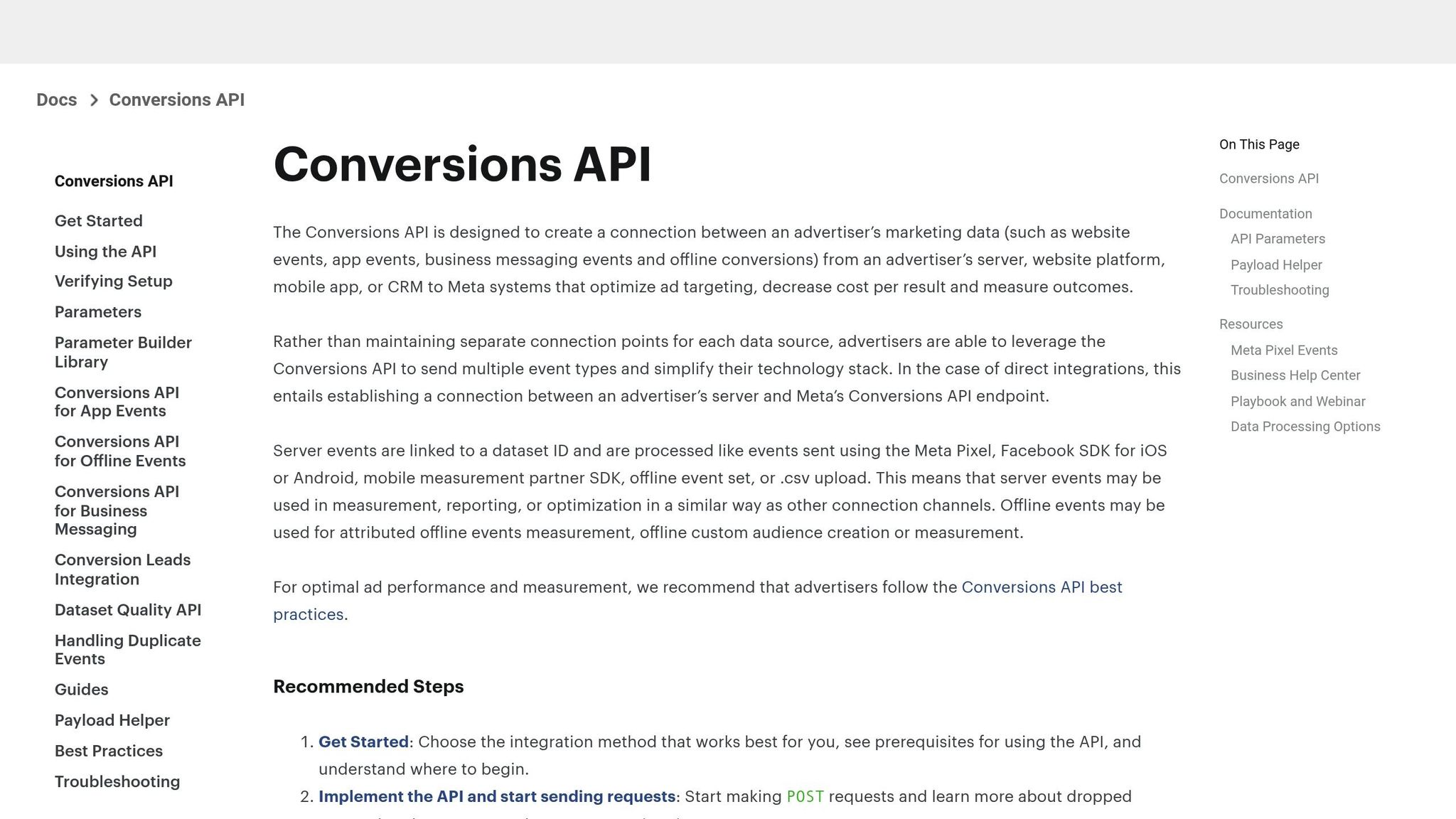
In May 2025, Meta phased out the Offline Conversions API, which had been used to track offline events like in-store purchases or phone orders. Advertisers have since been directed to the Conversions API (CAPI), which provides unified tracking for both online and offline events. Those transitioning to CAPI should monitor their Event Match Quality (EMQ) score in Events Manager to ensure accurate tracking [11].
How API Deprecations Affect Advertisers
API changes can shake up how advertisers manage campaigns, especially when it comes to tracking performance and fine-tuning strategies. These shifts go beyond just technical tweaks - they reshape the way you measure success and adapt your campaigns.
Changes to Performance Tracking and Reporting
Meta has made some sweeping changes to its Ads Insights API. As of October 30, 2024, over 100 unique metrics were removed, including key fields like unique_actions and cost_per_unique_action_type. Only four specific breakdowns remain: link_click, onsite_conversion_messaging_first_reply, onsite_conversion_total_messaging_connection, and outbound_click [12][5].
What does this mean for advertisers? You can no longer track unique metrics like purchases or add-to-carts through the API. Instead, you’re left with total action counts or "First Conversion" reporting, which may give an inflated view of your campaign's performance.
On top of that, attribution windows have been significantly shortened. Starting January 12, 2026, Meta eliminated the 7-day and 28-day view-through attribution windows (7d_view and 28d_view), leaving only shorter options like 1-day view or 1-day engaged view [7][2]. Queries using the deprecated parameters will now return empty data, forcing advertisers to adjust their tracking strategies.
Historical data access has also been restricted. Unique-count fields and hourly breakdowns are now capped at 13 months, while frequency breakdowns are limited to just 6 months [7][4]. If you haven’t exported older data yet, it’s now out of reach through the API.
Another major shift involves asynchronous processing for Marketing Mix Modeling (MMM) breakdowns. Real-time responses are a thing of the past. Now, you have to submit a request, wait for it to process, and then retrieve the results. This added delay can slow down your analysis and decision-making [7][2].
Here’s a quick overview of these changes:
Feature | Retention/Availability Limit | Effective Date |
|---|---|---|
Unique-count fields ( | 13 months | January 12, 2026 |
Hourly breakdowns | 13 months | January 12, 2026 |
Frequency breakdowns | 6 months | January 12, 2026 |
7-day & 28-day view-through | Deprecated (no data) | January 12, 2026 |
MMM breakdowns | Asynchronous jobs only | January 12, 2026 |
Reach data (with breakdowns) | 13 months | June 10, 2025 |
These changes don’t just affect reporting - they ripple into how you optimize campaigns.
Effects on Campaign Optimization and Audience Targeting
With these changes to data metrics, advertisers now face new challenges in targeting and creative control. For example, as of January 15, 2026, ad sets using deprecated Detailed Targeting interests will no longer run [13]. If you’re using these outdated interests, you’ll need to manually update your campaigns with the new consolidated interest groupings. Automated tools can help flag affected ad sets with a "Needs attention" filter, but the updates themselves require manual action. This is crucial because changing targeting impacts your estimated reach and costs.
"New interest selection must be done manually on behalf of the user because changing targeting will also change your estimated audience size, potentially the cost, as well as the Estimated Reach metric for your ads." - Brandwatch [13]
Advertisers also face reduced creative control. The "Standard Enhancements" bundle has been removed, which means you now need to individually enable Advantage+ Creative features like "Visual touch-ups", "Text improvements", and "Add overlays" [14]. This adds complexity to campaign setup and requires updated API calls.
For those running Special Ad Category campaigns - such as Housing, Employment, or Financial Products & Services - there are even more hurdles. Starting in March 2025, certain customer list custom audiences became ineligible unless you manually certify compliance using the is_sac_cfca_terms_certified field [5]. Failing to do so will block ad set creation entirely.
Other restrictions include the removal of Messenger Inbox placement and the reclassification of the "Credit" category under "Financial Products & Services" as of January 14, 2025. These changes further tighten audience targeting for specific campaigns [4].
With less granular data and fewer targeting options, advertisers are being nudged toward Meta’s AI-driven Advantage+ Audience approach. While this may simplify some aspects of campaign management, it also means giving up a degree of control over who sees your ads. This shift requires a new mindset for optimizing campaigns in a more automated, less customizable environment.
How to Prepare for Meta Ads API Changes
Getting ready for Meta Ads API updates now can save you from potential campaign interruptions and data issues later. Start by reviewing your current ad setups to pinpoint areas that might be affected by the upcoming changes.
Audit Your Current Ad Setups and Workflows
Begin with a full review of your codebase and reporting systems. Look for any fields that are being phased out and make the necessary replacements:
Replace
instagram_actor_idwithinstagram_user_idReplace
instagram_story_idwitheffective_instagram_media_idReplace
promotionswithpromotion_detailsShift detailed targeting exclusions to the
excluded_custom_audiencesfieldUpdate the
CREDITspecial ad category toFINANCIAL_PRODUCTS_SERVICES[4][6]
Make sure your reporting systems align with the updated attribution windows. If you're using 7-day or 28-day view-through windows, update them before January 12, 2026, to avoid losing data [4][2].
Historical data limits are also changing. Unique-count fields and hourly breakdowns now only go back 13 months, while frequency breakdowns are capped at 6 months [2]. If you haven’t exported older data yet, it’s already gone.
Important: Upgrade to API versions v23.0 or v24.0 by February 10, 2026, to keep your systems running smoothly [1][6]. You can also enable auto-upgrades for non-breaking endpoints in your developer portal to simplify future transitions [16].
Once your systems are updated, shift your focus to adopting new tools and strategies to maintain ad performance.
Find Alternative Tools and Solutions
Replacing outdated tools is critical to keep your campaigns running efficiently. For instance, the legacy Offline Conversions API will no longer work after May 2025. Transition to the Conversions API (CAPI) to continue tracking offline events [17]. Advertisers who combine Meta Pixel with CAPI have reported a 13% drop in cost per result and up to a 20% boost in reported conversions [11].
"We recommend that advertisers with existing Offline Conversions API integrations migrate to the Conversions API by May 2025..." - Meta [17]
For campaigns currently using Advantage Shopping (ASC) or Advantage App Campaign (AAC) APIs, switch to the unified Advantage+ structure by Q1 2026. This involves enabling three automation features: Advantage+ budget, Advantage+ audience, and Advantage+ placement [10]. Advantage+ sales campaigns have shown an average 22% lift in return on ad spend (ROAS) [10].
When setting up CAPI, include unique event IDs or deduplication keys to avoid double-counting conversions [11]. Regularly check your Event Match Quality (EMQ) Score in Events Manager - higher scores lead to better ad delivery and more accurate attribution [11].
Work with Experts Like Dancing Chicken
Navigating these updates can feel overwhelming, but working with specialists can make the process smoother. Agencies like Dancing Chicken specialize in server-side tracking, transitioning from legacy APIs to Advantage+ structures, and improving data quality through EMQ monitoring and deduplication [11][15].
These experts can also create CRM integrations that automatically trigger Meta events - like "Qualified Lead" or "Purchase" - when deals progress in your sales pipeline. This eliminates the need for manual data uploads and helps you adapt to deprecated features like detailed targeting exclusions or legacy objectives [11][17].
The results speak for themselves. Hydro Flask partnered with digital experts to grow its direct-to-consumer revenue by 247%, even amidst challenges like iOS 14.5 updates [15]. Burke Brands saw a 15x increase in clicks through tailored advertising strategies [15]. With Meta's API changes rolling out quickly, expert support isn’t just helpful - it’s essential for keeping your campaigns on track.
Conclusion
Meta's API deprecation notices signal major shifts in how advertisers manage tracking, reporting, and campaign optimization. Starting January 12, 2026, key changes will roll out, such as the removal of 7-day and 28-day view-through windows and stricter limits on historical data - 6 months for frequency breakdowns and 13 months for unique counts [7]. Additionally, Meta has already removed over 100 unique metrics from the Ads Insights API, and workflows like Marketing Mix Modeling are transitioning to asynchronous processing [12]. As Chris Cutlip from Meta emphasized: "To avoid disruption to your business, please review the list of deprecated metrics and ensure your business transitions away from using them" [3].
These updates require immediate attention. Delaying preparations could lead to data gaps, malfunctioning dashboards, and disrupted campaigns. Advertisers need to act now to meet the new requirements and maintain smooth operations.
Handling these technical updates - like replacing deprecated fields and adopting asynchronous jobs - can be complex. Agencies such as Dancing Chicken offer specialized expertise to help businesses navigate these changes, ensuring accurate tracking, compliance, and uninterrupted data flow.
FAQs
What steps should I take to prepare for the removal of detailed targeting interests in 2026?
To prepare for the removal of detailed targeting interests in 2026, it's time to shift gears and embrace broader targeting methods. Instead of relying on hyper-specific interest-based targeting, take advantage of Meta's advanced algorithms to fine-tune ad delivery and performance.
Focus your efforts on creative testing, experimenting with different ad formats and messaging to find what resonates best. Use first-party data to segment your audience effectively, and lean on lookalike audiences to expand your reach while maintaining relevance. Staying adaptable and forward-thinking will ensure your campaigns continue to deliver strong results as these changes take effect.
How will the updated Meta attribution windows affect my ad campaigns?
Meta is rolling out changes to its attribution windows starting January 12, 2026, and these updates could shift how you measure your campaign performance. Specifically, the 7-day view and 28-day view attribution windows are being removed. If you’ve been relying on these longer windows to track conversions, you might notice discrepancies in your reports moving forward.
To stay ahead, focus on the attribution windows Meta will continue to support: 1-day click, 7-day click, and 1-day view. Take time to review your reporting tools and optimization strategies now to ensure they align with these updates. Making adjustments early can help you maintain accurate insights into how your campaigns are performing.
How does switching to the Conversions API (CAPI) enhance offline conversion tracking?
Switching to the Conversions API (CAPI) allows businesses to track offline conversions more effectively. With CAPI, you can send offline event data - such as in-store purchases, phone orders, or point-of-sale transactions - directly to Meta. This provides a clearer and more precise view of activities that occur beyond your website.
By connecting online and offline data, CAPI gives advertisers deeper insights into customer behavior, helping them fine-tune campaigns and boost return on ad spend (ROAS).
Related Blog Posts
Meta Ads Compliance: Essential Rules for 2025
Meta Ad Policy Updates 2025
Ultimate Guide to Festive Meta Ads Targeting
How to Use Meta Ads API for Advanced Targeting