Compare niche vs broad Meta Ads targeting by budget, CPA, ROAS, creative needs and account maturity to choose the optimal or hybrid strategy.
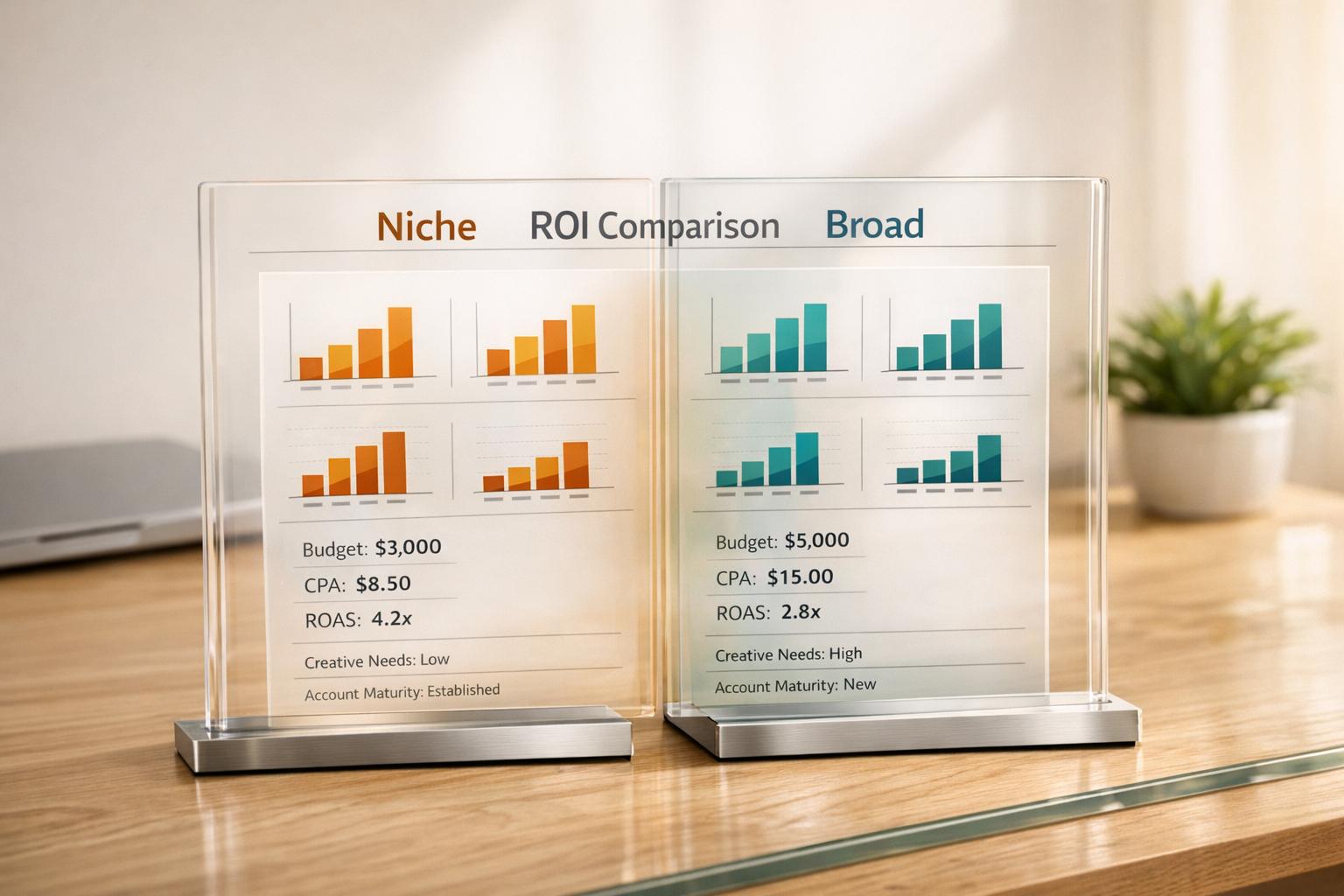
When running Meta Ads, deciding between niche and broad targeting can impact your ad performance and ROI. Here's a quick takeaway:
| Criteria | Niche Targeting | Broad Targeting |
|---|---|---|
| Best for | New accounts, small budgets, specific products | Mature accounts, large budgets, scalable campaigns |
| CPA | $42–$67 (lower for small budgets) | $35–$52 (lower for large budgets) |
| ROAS | 2.4–3.5× | 3.8–5.4× |
| Audience Size | Limited, risk of saturation | Virtually unlimited |
| Creative Assets Needed | 5–8 | 15–25 |
The choice depends on your budget, account maturity, and product type. Start niche for precision and testing, then shift to broad targeting as your account grows.

Niche vs Broad Meta Ads Targeting: ROI Comparison by Budget
Building on the earlier discussion, metrics for niche campaigns offer valuable insight into ROI performance and the effectiveness of targeted strategies.
Niche campaigns typically deliver strong performance, with conversion rates ranging from 1% to 3%. Campaigns with precise targeting often hit the higher end of this spectrum due to better audience alignment [3]. When it comes to ROAS (Return on Ad Spend), most campaigns fall between 200% to 600%, though well-planned niche strategies can surpass these figures [3].
Cost metrics align with industry norms but vary by sector:
These benchmarks highlight how niche targeting can optimize costs and performance when executed effectively.
Niche campaigns shine in their ability to attract higher-intent users who are more likely to convert. For example, targeting a group like "organic skincare and yoga enthusiasts" allows you to tailor messaging to their specific needs and interests, creating a more personalized and engaging experience [2]. This approach is especially useful for testing micro-segments to identify which audiences respond best to particular offers [2].
"Niche targeting... is compelling when your product or promotion is something that will appeal to a distinct subset of users." - Jason Loyed [2]
This strategy works particularly well when promoting products that address a specific problem or when running remarketing campaigns. It’s a great fit for brands with smaller budgets, as it delivers higher-quality leads and faster results, even if the overall audience size is smaller [2][3].
One of the main drawbacks of niche targeting is audience saturation. Performance often starts to dip after 7 to 14 days, as the small audience pool becomes overexposed to the ads [3]. This limited reach makes scaling a challenge once the initial segment is exhausted. Additionally, niche campaigns tend to have higher CPMs due to increased competition for these highly specific audience segments [2].
Data-related hurdles also pose significant challenges. For instance, 63% of digital marketing executives report difficulties in delivering tailored experiences, and 73% of businesses struggle to extract actionable insights from their marketing data [4][5]. Without proper tracking systems in place, niche campaigns may appear underwhelming in last-click attribution models, even though they contribute to assisted conversions [5].
To combat these issues, refreshing ad creatives regularly and testing at least three variations per ad set can help mitigate saturation and maintain performance [2].
When it comes to broad audience campaigns, the spotlight shifts to scale and algorithmic optimization rather than fine-tuned precision targeting.
For accounts generating 100+ weekly conversions, broad targeting stands out with a 27% lower CPA and 28% higher ROAS compared to interest-based campaigns. These accounts typically see ROAS in the range of 3.8× to 5.4×, with CPAs falling between $35 and $52. Budget size plays a critical role in performance: campaigns with daily spending under $3,000 often find interest targeting more cost-effective. However, as budgets increase, so do success rates - rising from 22% (under $500/day) to 51% ($1K–$3K/day) and peaking at 89% for budgets exceeding $10K/day.
Take, for example, a supplement brand that switched to broad targeting in late 2025. They reduced their CPA by 31%, dropping from $52 to $36, while scaling their daily spend to $15,000. This shift not only maintained their ROAS but also uncovered new customer segments, including gamers and shift workers. With Meta's AI now analyzing over 10,000 behavioral signals (a significant jump from 3,000 in 2023), the platform delivers quicker and more nuanced audience insights [1].
These results illustrate the scalability potential of broad targeting, which becomes even more evident when considering its advantages.
The biggest draw of broad targeting is its ability to scale. While interest-based campaigns tend to hit a ceiling at $80K–$150K per month, broad targeting can push past $200,000 monthly. Meta’s Advantage+ Shopping campaigns, which lean heavily on broad targeting, report 20–32% better CPAs compared to manually managed campaigns. With Detailed Targeting Expansion now the default, the algorithm often overrides manual settings to identify higher-performing audiences.
For brands with well-developed pixels and daily budgets above $3,000, broad targeting offers 15–35% lower CPAs, making it a go-to strategy for large-scale e-commerce operations and awareness campaigns. This scalability is a game-changer for businesses looking to allocate bigger budgets and move beyond the testing phase [1].
Despite its strengths, broad targeting isn’t without its challenges. Accounts spending less than $1,000 daily often face 38% higher CPAs compared to interest-based campaigns, as the algorithm requires at least 500 conversions and 100 weekly purchases to operate at its best.
"The algorithm is good enough now that constraining it with interests often hurts performance rather than helping - but only if you meet certain conditions."
Broad campaigns also demand a higher volume of creative assets - 15–25 variations compared to the typical 5–8 - making it essential to avoid audience fatigue and maintain ROI. Additionally, Event Match Quality scores need to be within the 80–100 range; scores below 60 indicate problems that could hinder results. For highly specialized or B2B products, broad targeting can struggle to identify the right audience, shifting the burden onto ad creatives to attract the right buyers while filtering out non-converters.
Understanding these limitations is key when deciding whether to opt for niche, broad, or hybrid strategies [1][6][7].
Niche and broad strategies each come with distinct trade-offs in ROI, depending on factors like account maturity and daily budget.
For accounts spending more than $3,000 daily, broad targeting outshines niche campaigns in cost efficiency. It delivers 27% lower CPAs ($35–$52 compared to $48–$71) and achieves 28% higher ROAS (3.8–5.4× versus 2.9–4.1×). Conversion rates also favor broad campaigns, which land between 3.8% and 5.2%, while niche campaigns hover around 3.2% to 4.4%[1].
On the flip side, for newer accounts spending less than $1,000 daily, niche targeting takes the lead. These campaigns achieve 38% lower CPAs ($42–$67 compared to $68–$105) and deliver stronger ROAS (2.4–3.5× versus 1.8–2.6×). At this stage, broad targeting often struggles because new accounts lack the conversion data needed for effective optimization[1].
The $3,000 daily spend threshold is a critical tipping point. Below this level, niche targeting offers tighter cost control and faster learning. Above it, broad targeting benefits from scale and Meta’s AI-driven optimization[1].
These differences in cost and conversions provide a foundation for understanding how each approach scales.
One of broad targeting's biggest strengths is its ability to scale without running into audience size limitations. Interest-based campaigns typically cap out at $80,000–$150,000 in monthly spend, while broad campaigns can exceed $200,000 per month[1]. This scalability is made possible by Meta’s algorithm, which identifies purchase intent across its entire user base, rather than being restricted to predefined audience segments.
However, scaling broad campaigns comes with a creative challenge. Broad strategies require 15–25 active creative assets to avoid audience fatigue and give the algorithm enough material to work with. In contrast, niche campaigns can scale effectively with just 5–8 assets, thanks to a more precise audience-product match[1].
Competition plays a key role in shaping the effectiveness of these strategies. Broad targeting often benefits from lower CPMs, as it avoids the intense bidding wars that arise when advertisers target narrowly defined audiences. By allowing Meta’s algorithm to find less-contested user groups, broad campaigns can keep costs in check[2][8].
That said, specialized products can flip this dynamic. For instance, a nootropics brand launched in early 2026 struggled with broad targeting, achieving just 0.8× ROAS while burning through $12,000 in three weeks. The algorithm mistakenly targeted general college students instead of the brand’s ideal biohacking audience. By switching to a layered interest-targeting approach (e.g., combining biohacking and entrepreneurship), the brand saw its CPA drop by 64% and its ROAS rise to 3.2×[1].
Broad targeting is well-suited for mass-market products appealing to diverse audiences, while niche targeting remains critical for specialized buyer profiles[1][8].
These insights highlight how businesses can strategically choose between niche, broad, or hybrid approaches to optimize their ad spend.
How you allocate your advertising budget depends on factors like account maturity, daily spending, and the type of product you're promoting. Knowing when to use niche, broad, or hybrid strategies can make a big difference in your campaign's effectiveness. These guidelines build on earlier ROI benchmarks to help you refine your ad spend based on your campaign’s stage and scale.
Niche targeting is ideal for high-ticket items (over $200), B2B services, and specialized products like technical cycling gear or biohacking supplements[1]. This approach works best for products that solve specific problems, offering precision in reaching the right audience.
For new accounts, it’s recommended to focus solely on interest targeting during the first 60 days to gather pixel data[1]. In this early phase, niche campaigns outperform broad targeting by 20–40% for accounts spending less than $1,000 daily[1]. Additionally, for products with longer sales cycles, targeted messaging aimed at specific pain points tends to perform better than generic, broad campaigns[2].
Broad targeting shines when scaling mass-market campaigns. It’s particularly effective for products that appeal to a wide audience, such as apparel, home essentials, and pet items. If your campaign generates 100+ purchase conversions weekly, broad targeting can help Meta’s AI identify high-intent buyers within its vast user base of 2.8 billion monthly active users[9].
The benefits of broad targeting become more apparent as your budget grows. Accounts spending over $3,000 daily see 27% lower CPAs and 28% higher ROAS[1]. With enough data, Meta’s algorithm optimizes performance, enabling broad campaigns to scale beyond $200,000 monthly - far exceeding the $80,000–$150,000 limits typically seen with interest-based campaigns[1]. Broad targeting is also a strong choice for top-of-funnel awareness campaigns, particularly when launching a new product and letting Meta’s AI determine who is most likely to convert[2].
Many top-performing Meta accounts use a hybrid approach, allocating 60–70% of their budget to broad targeting and 30–40% to interest targeting[1]. This strategy evolves with your account maturity. During the developing stage (60–120 days), prioritize interest targeting while testing broad audiences with a 70% interest, 30% broad split[1]. Once your account reaches the mature stage (120+ days), shift to a broad-dominant strategy, allocating 70–80% of your budget to broad campaigns[1].
Niche segments are also useful for testing new creative assets. If a new asset achieves a CPA below 1.3x your target, it’s ready to be scaled within broad campaigns[1].
For example, Dancing Chicken’s Growth plan ($1,500/month) supports this hybrid strategy with bi-weekly ad creative production and real-time analytics. Their Enterprise plan ($4,000/month) takes it further, offering AI-powered lead qualification and priority support for accounts spending over $30,000 monthly. Both plans include advanced ROAS-driven offer engineering to optimize performance across niche and broad campaigns.
Here’s a quick breakdown of how to align your strategy with your daily budget:
| Daily Budget | Recommended Strategy | Reasoning |
|---|---|---|
| Under $300 | Interest targeting (tight) | Focus on relevance and budget efficiency |
| $300–$1,000 | Interest targeting (broad interests) | Suitable for learning phase, still budget-conscious |
| $1,000–$3,000 | Hybrid (70% interest, 30% broad) | Transition phase for pixel data growth |
| $3,000–$10,000 | Broad primary, interest secondary | Enough data for algorithm optimization |
| Over $10,000 | Broad (Advantage+ Shopping) | Maximum efficiency and scalability |
The ROI benchmarks make one thing clear: selecting the right targeting strategy is essential for successfully scaling Meta Ads. Whether you lean toward niche or broad targeting depends on factors like your account's maturity, budget, and overall business objectives. As Meta Ads Strategist Aravinth Rajagopalan explains:
"Broad vs Interest isn't a binary question. It's a system decision." [10]
The effectiveness of your strategy hinges on elements like pixel data, conversion volume, and the strength of your ad creatives.
For newer accounts or products with a very specific audience, niche targeting offers the precision needed to gather data and connect with the right people early on. However, as your pixel matures - typically beyond 200 conversions per month - broad targeting becomes a powerful tool for scaling. With more data, the algorithm gets better at identifying high-intent buyers, delivering stronger results than interest-based campaigns can achieve at scale.
Combining both approaches often yields the best outcomes. Successful advertisers rarely stick to just one method. A hybrid strategy - allocating most of your budget to broad targeting while using a smaller portion for interest-based campaigns - allows you to scale effectively while testing new creative ideas and building retargeting audiences. Over time, as your account grows and accumulates data, the balance naturally shifts toward prioritizing broad targeting.
It's worth noting that 90% of poor performance stems from issues with creative or offers, not targeting. Even the most precise targeting won't save an ad with weak messaging. In broad campaigns especially, your visuals and copy need to resonate deeply with your ideal audience, addressing their pain points and needs directly.
For advertisers spending over $30,000 a month, expert guidance can make all the difference. Dancing Chicken's Enterprise plan offers AI-powered lead qualification, enterprise-grade attribution, and 24/7 priority support to help you get the most out of your Meta Ads. Their data-driven approach ensures you're equipped to handle the complexities of Meta advertising while staying agile enough to adapt to platform changes.
To figure out if your account is set up for broad targeting on Meta, take a look at its maturity and performance history. Broad targeting tends to deliver the best results for accounts that show consistent performance, use proven creatives, and have a daily budget of at least $3,000. Accounts that have successfully completed the learning phase and built up enough historical data for Meta’s AI to optimize efficiently are in a great position. On the other hand, newer accounts might see better outcomes by starting with more targeted strategies first.
Meta's broad campaigns thrive on adequate conversion volume to deliver strong results. To make them work, it's often best to scale budgets gradually while keeping a close eye on metrics like ROAS (Return on Ad Spend), CTR (Click-Through Rate), and CPA (Cost Per Acquisition). While Meta doesn't specify a minimum volume, success typically hinges on maintaining consistent performance and continuously testing audiences to refine your approach.
To effectively manage a hybrid budget setup, allocate approximately 70% of your budget to prospecting (targeting broad audiences) to attract new customers, and 30% to retargeting (focusing on niche audiences) to convert users who have already shown interest. Leverage tools like Campaign Budget Optimization (CBO) to streamline prospecting efforts, and concentrate retargeting on audiences with high engagement levels. When scaling your budget, increase it gradually - by no more than 20% every 3-4 days - to maintain stable performance and achieve the best return on investment (ROI).
When it comes to Meta ads, many brands don’t realize just how profitable the platform can actually be. Or even worse, an agency overpromised and underdelivered... leaving them frustrated with a fortune spent on ineffective campaigns.
Our clients see amazing results from Meta ads. That’s because we cover every angle—from targeted reach to dynamic creative testing to retargeting and more. With our full-funnel strategy and deep platform expertise, we make sure your Meta ads drive maximum profitability, every step of the way.
%20(1).png)
.svg)
