Digital Marketing
Meta Ads Scaling vs. Optimization: Key Differences
Understand the difference between Meta Ads optimization and scaling, when to optimize first, and tactics to scale gradually while protecting ROAS.

Scaling and optimization are two distinct yet interconnected strategies for running successful Meta Ads campaigns. Here's the short version:
Optimization: Focuses on improving efficiency. This involves testing, refining targeting, adjusting bids, and analyzing performance to lower costs and increase your return on ad spend (ROAS). It’s about making the most of your current resources.
Scaling: Increases the reach of a campaign that’s already performing well. This means spending more to scale your revenue and profits while maintaining profitability. Scaling can be done vertically (raising budgets gradually) or horizontally (duplicating ad sets to target new audiences).
Key Insights:
Scaling without proper optimization often fails - 73% of campaigns scaled too early see performance drop within the first week.
Meta’s algorithm needs at least 50 conversions per week to scale effectively.
Optimization ensures campaigns are stable and efficient before scaling begins. Without it, scaling can lead to wasted budgets and poor results.
Quick Overview:
Optimization: Fine-tunes campaigns, tests new ideas, and improves metrics like cost per acquisition (CPA) and ROAS.
Scaling: Expands proven campaigns, growing impressions and conversions while keeping costs manageable.
Both strategies must work together. Optimize first to stabilize performance, then scale gradually to grow revenue while maintaining efficiency.
What is Meta Ads Scaling?
Meta Ads scaling is all about increasing ad spend on campaigns that are already performing well. The goal? To expand your reach, gain more impressions, and drive even more conversions [8][9]. When you scale, you're essentially signaling to Meta's algorithm that your campaign is ready to grow. But scaling isn’t just about throwing more money at ads - it’s about doing so strategically to maintain profitability.
That said, scaling comes with its challenges. If you increase your budget too quickly, Meta’s algorithm may enter a new learning phase. This can lead to unpredictable performance and higher costs [6]. To navigate this, it’s essential to understand the two main scaling methods: vertical scaling and horizontal scaling. Each has its own approach, risks, and best-use scenarios.
Vertical Scaling
Vertical scaling focuses on increasing the budget of existing, high-performing ad sets. The key is to do this gradually - typically by 20–30% every 48–72 hours. Why? Sudden jumps, like increasing a budget from $100 to $500, can reset the learning phase, leading to higher costs per acquisition (CPA) and lower return on ad spend (ROAS) [9].
This approach is most effective when your audience is large and your frequency metric (the average number of times each user sees your ad) is low. If your frequency starts creeping above 2.5 to 3.0, it could mean your audience is becoming saturated. At that point, further budget increases might deliver diminishing returns [2].
Horizontal Scaling
Horizontal scaling takes a different route. Instead of increasing the budget on a single ad set, you duplicate successful ones and target new audiences. This might involve experimenting with different lookalike audience percentages, interest groups, or geographic regions [1][9].
One of the biggest advantages of horizontal scaling is that it avoids audience saturation while spreading out risk. However, it does require more hands-on management. You’ll need to monitor multiple ad sets to ensure they don’t compete with each other in Meta’s auction system [2]. A good strategy is to test lookalike audiences in stages - starting with 1%, then moving to 3%, and eventually 5% - to find the right balance between precision and scale [6].
What is Meta Ads Optimization?
Meta Ads optimization is all about fine-tuning your campaigns to get better results. It focuses on lowering your cost per acquisition (CPA) and increasing your return on ad spend (ROAS) through a constant process of testing, learning, and making adjustments [1]. This ongoing refinement helps you create actionable strategies backed by clear performance metrics.
Meta’s algorithm today prioritizes quality over quantity. Instead of chasing a high volume of low-quality data, it now favors fewer, high-intent conversions [10]. To align with this shift, it’s crucial to focus on clean conversion signals - this includes accurate tracking through tools like the Meta Pixel and Conversions API (CAPI) - and on creating ads that truly resonate with your audience. As Extuitive points out, optimization has moved from reactive tweaks in Ads Manager to proactive strategies designed to cut down on wasted ad spend [10]. This sets the foundation for smarter adjustments and better tracking of performance.
Common Optimization Tactics
A strong optimization strategy often involves testing 20–30 creative variations to help Meta’s algorithm work more efficiently [12]. Your creative content plays a huge role here - it acts as the primary signal for targeting, guiding the algorithm to find users most likely to convert based on how they engage with specific elements like hooks or formats [10][12].
Another effective tactic is using strategic exclusions. For instance, excluding recent purchasers or website visitors pushes the algorithm to discover fresh demand instead of over-relying on retargeting [10][11]. To safeguard your ROAS, consider using Cost Caps or Manual Bids, and make small budget adjustments (around 10%) rather than large changes that could reset the learning phase [12]. Additionally, implementing CAPI ensures better data quality and avoids duplication, which is especially important given the growing limitations of browser-based tracking [11][12].
Performance Metrics in Optimization
Tracking the right metrics is key to evaluating your optimization efforts. Cost per acquisition (CPA) tells you how much you’re spending to get each conversion, and it should be compared to your customer lifetime value and profit margins [13]. Meanwhile, return on ad spend (ROAS) is the ultimate gauge of campaign profitability, though it can vary depending on the attribution window you’re using (e.g., 7-day click vs. 1-day view) [13].
For a quick relevance check, look at your click-through rate (CTR) - a low CTR might mean your creative isn’t connecting with your audience [13]. If you’re running video ads, metrics like Thumb Stop Rate (3-second views divided by impressions) and Hold Rate (full plays divided by 3-second views) can show how well your content grabs and holds attention [5]. Keep in mind, Meta’s algorithm generally needs at least 50 conversion events within 7 days to exit the learning phase [3][4][13][14].
Scaling vs. Optimization: Main Differences
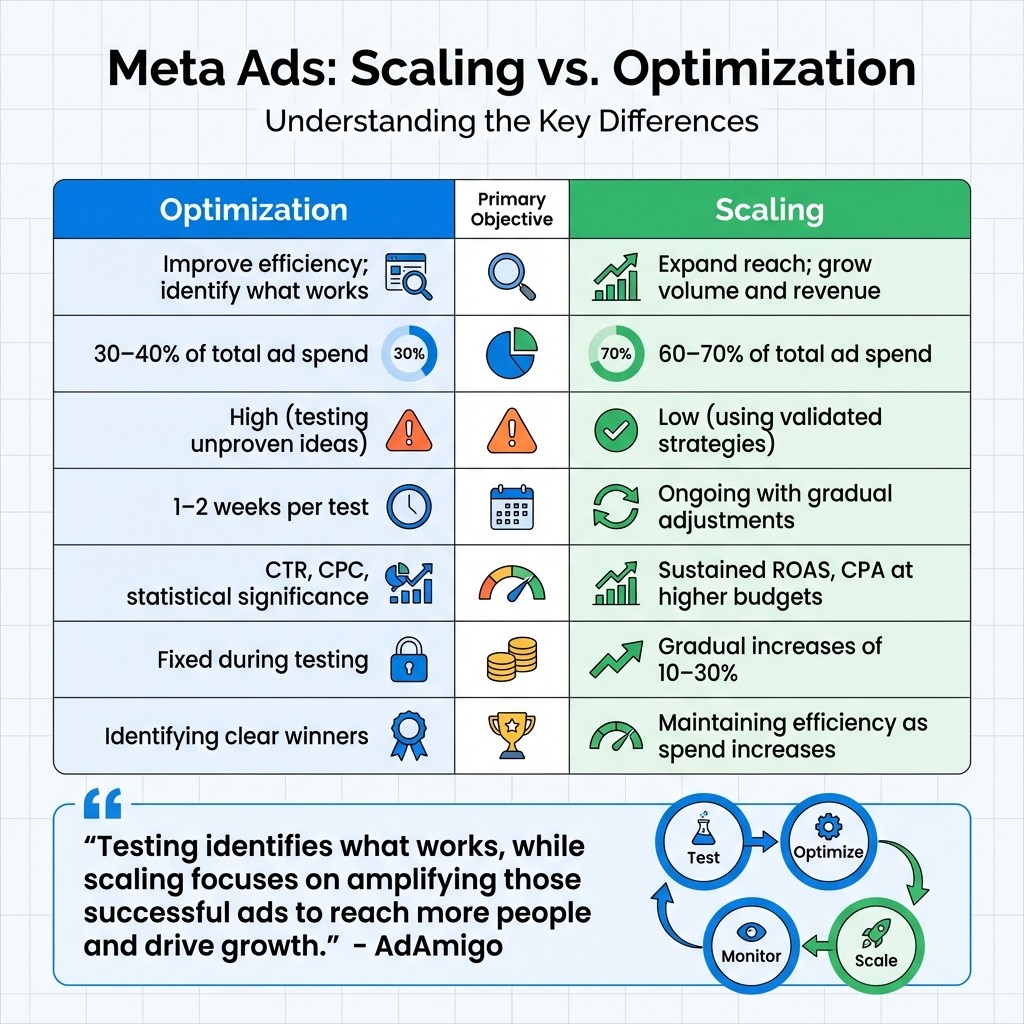
Meta Ads Scaling vs Optimization: Key Differences and Strategy Comparison
Scaling and optimization both aim to improve your Meta Ads performance, but they approach the goal from completely different angles. Optimization focuses on fine-tuning your current assets for better efficiency, while scaling is about expanding your reach - amplifying campaigns that are already proven to work in order to engage more people and generate higher revenue [7]. Picture optimization as perfecting the engine of a car, while scaling is about hitting the gas once everything is running smoothly.
The key difference lies in their goals: optimization strives for better results using the same resources, while scaling works to achieve more results without sacrificing quality [7]. Optimization involves testing new ideas, which naturally carries higher risks, whereas scaling relies on strategies that have already been validated, making it a lower-risk endeavor [15]. Typically, advertisers allocate 30–40% of their budget to testing and 60–70% to scaling campaigns that have already demonstrated success [15]. This balance of risk and reward directly influences the outcomes and trajectory of your campaigns.
"Testing identifies what works, while scaling focuses on amplifying those successful ads to reach more people and drive growth." - AdAmigo [15]
The results of each approach are also distinct. Optimization helps you identify top-performing creatives, stabilize performance metrics, and cut unnecessary spending - essentially laying the groundwork for future growth. Scaling, on the other hand, focuses on increasing revenue and market share, though it often comes with a 10–15% efficiency trade-off as you expand into new audiences [7]. A real-world example highlights this: one brand, after rigorously testing and optimizing their creative assets, achieved a staggering 1,810% increase in sales by scaling their best-performing campaign, boosting their ROAS from 63% to 401% [15].
Here’s a quick breakdown of the differences:
Comparison Table
Aspect | Optimization | Scaling |
|---|---|---|
Primary Objective | Improve efficiency; identify what works [15] | Expand reach; grow volume and revenue [15] |
Budget Allocation | 30–40% of total ad spend [15] | 60–70% of total ad spend [15] |
Risk Level | High (testing unproven ideas) [15] | Low (using validated strategies) [15] |
Timeline | 1–2 weeks per test [15] | Ongoing with gradual adjustments [15] |
Key Metrics | CTR, CPC, statistical significance [15] | Sustained ROAS, CPA at higher budgets [15] |
Budget Changes | Fixed during testing [15] | |
Success Indicator | Identifying clear winners [15] | Maintaining efficiency as spend increases [7] |
When to Scale Your Meta Ads Campaigns
Signs Your Campaign is Ready to Scale
Scaling a Meta Ads campaign is all about timing. A few good days of performance aren't enough - consistency is the real indicator. One of the first signs you're ready to scale is conversion volume. Your campaign should consistently hit at least 50 conversions per week. This gives Meta’s algorithm enough data to optimize effectively and deliver better results [2].
Next, check your budget utilization. If your campaign is consistently spending 85–100% of its daily budget while maintaining a stable ROAS or CPA (within a 15% range) for seven straight days, it’s a good sign you’re ready to move forward [2]. However, if Meta isn’t using your full budget, increasing it won’t magically improve performance.
You’ll also want to ensure you have a profitability buffer. Ideally, your campaign should be performing at least 30% above your break-even point. This cushion helps you absorb the typical 10–15% efficiency dip that often occurs during scaling [2]. And don’t overlook frequency - if it’s already above 2.5–3.0, you’re likely showing ads to the same audience too often, which can lead to creative fatigue.
Finally, don’t put all your eggs in one basket. If you’re relying on a single winning ad, scaling could backfire. Instead, have 3–5 strong-performing creatives ready so your campaign isn’t overly dependent on one “hero” ad [2].
Recognizing these signals is crucial because scaling too soon can introduce more risks than rewards.
Risks of Scaling Too Early
Scaling prematurely can disrupt your campaign’s structure and lead to costly mistakes. One major pitfall is resetting the learning phase. If you increase your budget by more than 20% at once, Meta treats this as a "significant edit", causing the algorithm to restart its learning process. This often results in 3–5 days of performance volatility [2][3][17].
Another common issue during premature scaling is rising CPMs. Costs can spike by 25% or more, while conversion rates can drop by over 15%. In extreme cases, performance can degrade by as much as 50% [6][7].
A less obvious but equally damaging risk is poor pixel match quality. If your pixel match score is below 7.0, Meta’s algorithm struggles to optimize effectively. Scaling under these conditions amplifies bad data signals, wasting your budget on audiences that are unlikely to convert [2].
The takeaway? Wait at least seven days of stable performance after exiting the learning phase before increasing your budget. Rushing this process often leads to wasted spending and underwhelming results. By balancing readiness signals with an understanding of these risks, you can scale efficiently while protecting your campaign’s performance [2].
When to Optimize Before Scaling
Problems That Require Optimization First
Before increasing your budget, it’s crucial to address any issues that could destabilize your campaign. Not every campaign is ready for scaling. For instance, if your return-on-ad-spend (ROAS) fluctuates wildly, it’s a clear sign of inconsistent performance. A stable ROAS - one that stays within a 15% range over a 30-day period - is essential before scaling [2]. Without this stability, additional spending could simply magnify existing inefficiencies.
Scaling a campaign with weak fundamentals can lead to disastrous results. One major warning sign is low conversion volume. Meta’s algorithm relies on a minimum number of conversions to identify meaningful patterns. If your campaign isn’t hitting that threshold, it risks making decisions based on incomplete data [2][7].
Also, keep an eye out for creative fatigue. Indicators like rising CPMs, declining click-through rates, and a frequency above 3–4 for cold audiences suggest your ads are losing their appeal. Another key metric to monitor is your "Thumb Stop Rate" - the ratio of 3-second video views to impressions - which should stay above 30–40% [18][5]. If these metrics drop, your creatives may no longer be effective, and scaling could worsen the situation.
Tracking issues are another potential pitfall. A Pixel match quality score below 7.0 or a lack of the Conversions API (CAPI) can lead to undercounting conversions by as much as 20–30% [18][2]. Additionally, campaigns stuck in or frequently re-entering the Learning Phase indicate an unstable foundation that’s not ready for scaling [11][7]. These issues must be resolved to ensure your campaign is prepared for growth.
Steps to Optimize Before Scaling
Once you’ve identified performance bottlenecks, take specific steps to optimize your campaign. Start by auditing your tracking setup. Use Meta’s Pixel Helper to ensure key events like "Add to Cart" and "Purchase" are being tracked correctly on every page. If you haven’t already implemented the Conversions API, do so, and make sure it’s properly deduplicated with your Pixel to avoid double-counting conversions [11][18]. Accurate tracking is essential for reliable performance data.
Next, streamline your campaign structure. Consolidate overlapping ad sets to help each one gather enough data for Meta’s algorithm to work efficiently [5][18]. Instead of spreading your budget thinly across multiple campaigns, focus on building fewer, more robust ones.
Address creative fatigue by refreshing your ad assets. Experiment with new hooks, update visual styles, or incorporate user-generated content (UGC) [18][5]. Having a variety of 3–5 high-performing creatives ensures you’re not overly dependent on a single ad, which could quickly burn out during scaling [2].
Finally, confirm that your campaign objective aligns with your actual goals. For example, if your campaign is optimized for "Traffic" but your goal is sales, Meta will prioritize clicks over purchases [18][11]. This kind of misalignment can waste your budget, regardless of how much you spend. Adjust the objective, let the campaign stabilize for at least seven days, and then reassess its readiness for scaling [2].
How Scaling and Optimization Work Together
Balancing Growth and Efficiency
As we've discussed earlier, continuous testing is key to refining campaigns. But how do you balance growth while maintaining efficiency? Scaling and optimization are not separate processes - they're interconnected steps in an ongoing cycle. Optimization lays the groundwork by testing creatives, fine-tuning audience targeting, and improving conversion rates. Once you've identified the winning combinations, scaling helps you expand their reach, driving revenue growth. However, scaling comes with challenges, as it can disrupt previously stable performance[4].
"Optimization is the engine of growth... It's not about finding a magical setup that works forever. It's about creating a cycle of testing, learning, and adjusting." – Oboe [1]
This cycle requires constant movement between optimization and scaling. For example, during scaling, you might encounter audience saturation or creative fatigue, leading to a drop in performance. When this happens, it's time to pause scaling and return to optimization - whether that means refreshing creatives, exploring new lookalike audiences, or experimenting with different ad formats[16]. Once performance stabilizes again, you can resume scaling. This back-and-forth approach helps advertisers grow campaigns while staying profitable.
One critical rule during scaling is to stick to a 20% daily budget increase to prevent triggering the learning phase[16]. Even during aggressive scaling, keep testing new creatives to ensure you have fresh assets ready when current ones lose effectiveness.
Monitoring and Adjusting Campaigns
Effective scaling relies on disciplined monitoring to ensure every adjustment pays off. After increasing your budget, wait 3–4 days for the algorithm to adapt before making further changes. Avoid scaling based on a single good day - only move forward after at least 7 days of consistent performance[16].
Set clear thresholds to protect profitability. For example, if your ROAS drops by more than 25% or your CPA rises by over 30%, pause scaling and investigate the cause[16]. Keep an eye on frequency as well - if it exceeds 3.0 for cold audiences, it may signal saturation, meaning it's time to introduce new creatives or expand your audience pool[16]. Similarly, a 20% drop in click-through rate indicates creative fatigue, which calls for immediate action[16].
When vertical scaling leads to higher CPMs and diminishing returns, consider horizontal scaling instead. This involves duplicating successful ad sets and targeting fresh audience segments[2]. By doing so, you expand your market reach without overloading the same audience. Monitor these metrics daily to catch issues early, rather than waiting for weekly reviews. This proactive approach ensures your campaigns remain dynamic, balancing growth with efficiency.
Tools and Methods for Scaling and Optimization
Scaling and optimization strategies rely heavily on the right tools and account frameworks. Here's how you can use Meta's tools and campaign structures to implement these strategies effectively.
Meta Ads Native Tools
Meta offers several tools designed to streamline both scaling and optimization efforts. For scaling, Campaign Budget Optimization (CBO) is your go-to. It manages a single budget across multiple ad sets, automatically reallocating funds to the best-performing ones in real time[19][23].
When you're focused on optimization - testing new creatives, audiences, or offers - Ad Set Budget Optimization (ABO) provides more control. This method allows you to set specific budgets for each ad set, ensuring that every test gets the spending it needs to gather meaningful results[20][21].
Automated Rules can support both scaling and optimization. For example, you might create rules to increase budgets by 20% if your CPA stays low for three consecutive days. On the flip side, you can implement stop-loss rules to pause ads if the CPA exceeds your set threshold by 30%[21][22]. For advertisers juggling multiple campaigns, Advantage+ Shopping Campaigns simplify the process. These campaigns use Meta's AI to handle targeting and creative optimization, often achieving double-digit efficiency gains compared to manual management[24].
These tools form the backbone of a solid campaign setup, which leads us to the importance of account structure.
Campaign Structure Frameworks
Your account structure plays a key role in enabling smooth scaling. As discussed earlier, combining testing and scaling efforts into a unified system ensures Meta's algorithm receives clear, strong signals. A proven method is to separate your "testing lab" from your "scaling factory."
Here’s how it works: Use a Creative Testing campaign with ABO to allocate 10–20% of your budget for testing new ideas, such as hooks and angles. Once a creative performs well - typically after about 7 days of consistent results - you can move it into your scaling campaigns, which run on CBO or Advantage+ Shopping[20][24].
"The difference between accounts that scale profitably and those that plateau at $500/day often comes down to structural decisions made during setup." – AdStellar[20]
High-performing accounts tend to operate with just 3–5 core campaigns, such as Prospecting, Retargeting, Existing Customers, and Creative Testing[24]. Consolidating similar audiences into fewer campaigns with larger budgets strengthens Meta's algorithm, making it easier to target buyers effectively and efficiently. This streamlined structure is often the difference between campaigns that scale profitably and those that stagnate.
Conclusion
Scaling and optimization go hand in hand. While optimization lays the groundwork by refining strategies and testing thoroughly, scaling takes those proven strategies and expands their impact. Ignoring either one can lead to wasted resources or missed revenue opportunities.
The most effective Meta Ads accounts follow a continuous cycle: testing identifies successful creatives and audiences, scaling amplifies those successes, and when performance dips due to audience saturation or creative fatigue, the process starts again. This ongoing loop of testing and scaling is what keeps growth consistent and sustainable[15].
The numbers back this up. Advertisers who allocate 30–40% of their budget to creative testing and optimization, while dedicating 60–70% to scaling winning assets, tend to see the most consistent results. This balanced approach ensures that fresh, effective content is always fueling the scaling process, while also making the most of strategies that are already working[15].
Final Thoughts
As we've explored, combining optimization with scaling is the foundation of successful campaigns. Campaigns that scale profitably don’t rely on luck or massive budgets - they succeed because of a solid methodology[2].
Before scaling, ensure your campaigns have a stable ROAS (within a 15% range) and are generating at least 50 conversions per week[2]. When you're ready to scale, do it gradually - limit increases to 20–30% every 2–3 days to avoid destabilizing performance[3].
Optimization, however, doesn’t stop once scaling begins. It's an ongoing process. Regularly evaluate your campaign metrics. If your CPA is stable and well below your target, it’s a green light to scale. But if performance is inconsistent or costs are creeping up, it’s time to refocus on optimization. Your strategy should always align with your current campaign performance and your business goals.
FAQs
How can I tell if my campaign’s ROAS is stable enough to scale?
To determine if your campaign’s ROAS is stable enough for scaling, look for consistent performance metrics. These include maintaining a ROAS within your target range (e.g., 2.5–4.0 for e-commerce), a steady CPA, and having enough data to make informed decisions - usually at least 30–50 conversions per ad set. These benchmarks help confirm performance reliability before increasing your budgets.
Which is better for me right now: vertical scaling or horizontal scaling?
Vertical scaling works well when you aim to gradually increase budgets on campaigns that are already delivering strong results. This method allows you to boost performance while keeping risks in check, making it a dependable way to enhance the effectiveness of your Meta Ads campaigns.
What should I do if scaling makes my CPA spike or ROAS drop?
If you notice a spike in CPA or a drop in ROAS while scaling, take a gradual approach to increasing budgets. Aim for a 10-20% increase every 24-48 hours to keep the algorithm's learning process stable. Keep a close eye on key metrics like CPA and ROAS, and steer clear of sudden, dramatic budget changes that could throw off performance.
Related Blog Posts
5 Meta Ads Scaling Tips for Long-Term Growth
Horizontal vs Vertical Scaling in Meta Ads
Meta Ads Budget Allocation: Best Practices for ROAS
Scaling Meta Ads with Ad Set Structuring