Structure ad sets, consolidate audiences, and increase budgets gradually to scale Meta Ads while protecting ROAS and avoiding learning-phase resets.
Scaling Meta Ads effectively means increasing your ad spend without sacrificing performance metrics like ROAS or CPA. The key? Structuring ad sets to work with Meta’s algorithm, not against it. Over-segmenting campaigns or making abrupt budget changes often disrupts the learning phase, leading to higher costs and lower returns. Instead, focus on:
Scaling Meta Ads might look simple at first glance, but doubling your ad spend rarely results in double the conversions. In fact, it often brings unexpected hurdles that can hurt performance and drive up costs. Understanding these challenges is key to protecting your return on ad spend (ROAS). Let’s break down some of the most common obstacles advertisers face when scaling their campaigns.
Meta's algorithm needs time and data to fine-tune ad delivery. When you increase budgets by more than 20–50% or make structural changes - like tweaking audiences or duplicating ad sets - you reset the learning phase. This forces the algorithm to start over, reoptimizing how it targets users. During this reset, which typically lasts 3–7 days, you might see your cost per acquisition (CPA) spike by 30–100%, along with a drop in conversion rates as Meta tests new audience segments and placements [2][4][5].
For instance, an ecommerce brand increased its daily ad set budgets from $50 to $200. This triggered a learning reset, causing their CPA to jump from $15 to $30 over five days. In another case, an advertiser duplicated a high-performing ad set to scale faster, but splitting the conversion data across multiple ad sets led to a 40% drop in efficiency until the sets were consolidated. The issue isn’t the act of scaling - it’s the way these changes disrupt the data flow Meta depends on for optimization [4][5].
But learning phase resets aren’t the only challenge. Creative fatigue and audience saturation can also derail your scaling efforts.
Ad fatigue happens when users see the same ads too often, eventually tuning them out. This usually kicks in after 1–2 weeks, especially when ad frequency rises above 3–5 impressions per user. As a result, click-through rates (CTR) can drop by 40–60%, while cost per thousand impressions (CPM) can increase by more than 20% week over week [2][4].
Audience saturation is a related issue, especially with narrowly defined segments like small lookalike audiences or specific interest groups. As these high-intent users are exhausted, Meta starts showing ads to lower-quality users within the same group, which can cut your ROAS from 3× to 1.5× or worse. Watch for frequency metrics exceeding 7 and reach plateaus in Ads Manager, as these are signs of audience saturation. Over-segmenting your campaigns into too many narrow ad sets can make this problem worse by restricting Meta’s ability to find high-converting users outside your predefined groups [2][4][6].
These issues often pave the way for another major challenge: declining ROAS as budgets increase.
When advertisers rapidly increase budgets - say, from $100 to $500 per day - ROAS often drops by 25–50%. This happens because the algorithm shifts spending from high-value audiences to broader, less effective ones [4][5]. Over-segmentation can make things worse. If you’re running more than five ad sets per campaign, with each receiving less than $50 daily, they may not collect the 50+ conversions per week needed to exit the learning phase. This can lead to ROAS declines of 20–40% compared to campaigns with more consolidated ad sets [2][4][5].
Meta advises combining fragmented ad sets to improve performance, but many advertisers don’t realize this until their campaigns start to underperform. Consolidation can help the algorithm focus on the best opportunities, reducing inefficiencies caused by spreading budgets too thin.
The way you set up your ad sets plays a big role in how well Meta's algorithm can scale your campaigns. A well-organized ad set ensures consistency in key areas like objectives, optimization events, conversion windows, placements, and audience size. This consistency allows the algorithm to build a strong performance history instead of constantly starting over [2][4]. By consolidating audiences into fewer, higher-budget ad sets - rather than spreading them across many smaller ones - Meta collects more conversion data per ad set. This improves bidding accuracy and helps stabilize your cost per acquisition (CPA) [4][5]. Let’s dive into how a streamlined structure can enhance algorithm stability.
Algorithm stability depends on giving Meta enough data to make informed decisions. Using a simplified, consolidated ad set structure - typically 3–5 ad sets per campaign - helps the algorithm learn faster [8][4][5]. Avoiding frequent edits and ensuring each ad set has enough budget to exit the learning phase prevents disruptive resets that can spike your CPA and waste your ad spend.
For example, a U.S.-based e-commerce brand running one Campaign Budget Optimization (CBO) campaign with three distinct ad sets - Broad US 18–54, 2% Purchase Lookalike US, and Interest Stack US - can gradually increase the campaign budget from $300 to $1,000 per day. Since each ad set maintains its performance history, the learning phase remains stable, and scaling becomes more efficient [2][4][5].
Scaling your campaigns can happen in two ways: vertical scaling and horizontal scaling.
The structure of your ad sets is critical for both approaches. For vertical scaling, consolidated ad sets with well-defined targeting help the algorithm handle larger budgets without issues. For horizontal scaling, clearly labeled and non-overlapping ad sets (e.g., US broad, US 2% lookalike, and remarketing) allow for clean comparisons and prevent audience overlap, which could lead to cannibalization [4][5][6].
A global study on campaign structures found that consolidating similar campaigns into one - with multiple ad sets - resulted in 41% more conversions compared to fragmented setups [8]. These strategies not only improve scaling but also lay the groundwork for precise testing and performance measurement.
A structured approach doesn’t just make scaling easier - it also simplifies testing and performance tracking. A disciplined ad set structure allows for cleaner, faster testing. For example, you can test one variable at a time by keeping the same audience and placements across ad sets but changing the creative. Clear naming conventions (e.g., US | Prospecting | Broad | AEC | $300 CBO) make it easier to analyze results and make quick decisions [3][4].
Consistency across test ad sets - such as using the same budget type, optimization settings, conversion windows, and placements - reduces noise in your results [4][7]. This clarity supports a focused scaling strategy. As Dancing Chicken explains:
"We make data driven decisions and track using custom columns within your dashboard, integrating unique UTMs and tagging - so we can make the right decisions, every time" [1].
Limiting the number of concurrent test ad sets and ensuring each one has enough budget to generate meaningful conversion data speeds up your results. This approach minimizes wasted ad spend and delivers statistically reliable outcomes more efficiently [4][5][7].
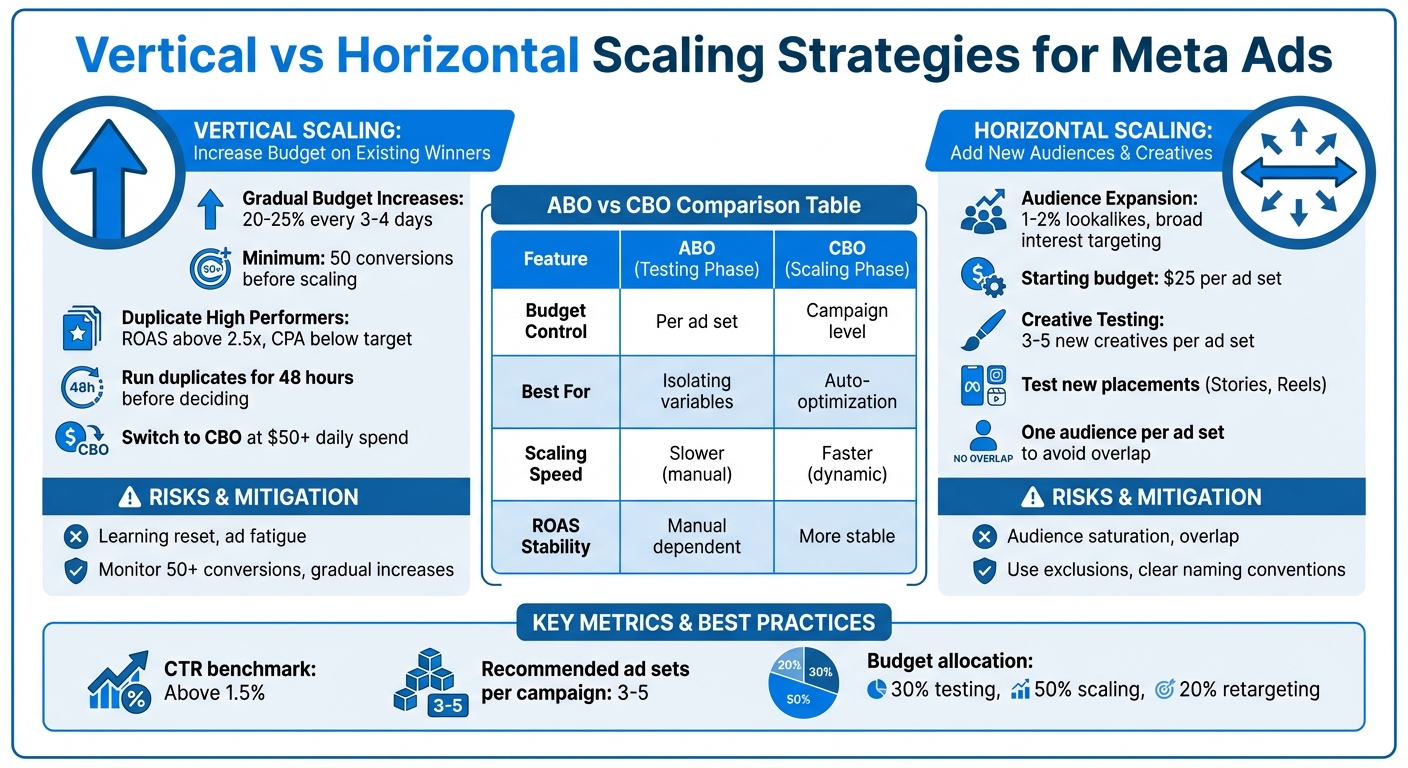
Vertical vs Horizontal Scaling Strategies for Meta Ads
Structuring your ad sets effectively is key to scaling your campaigns successfully. Whether you’re increasing budgets on proven performers (vertical scaling) or branching out into new audiences and creatives (horizontal scaling), the way you organize your ad sets can make or break your scaling efforts.
Vertical scaling focuses on increasing budgets for ad sets that are already delivering strong results. The goal is to boost spending without resetting the learning phase or driving up costs. Here’s how to do it:
Audience | Scale_v2 | Budget_$50). Run the duplicate for 48 hours, and if it outperforms the original, turn off the original to avoid audience overlap and ad fatigue [3][6].
Here’s a quick comparison of ABO and CBO for vertical scaling:
| Aspect | ABO (Ad Set Budget Optimization) | CBO (Campaign Budget Optimization) |
|---|---|---|
| Setup | Budget set per ad set for precise control [4] | Budget set at campaign level, auto-allocates to top performers [4] |
| Testing Suitability | Ideal for isolating variables [4][6] | Less ideal; harder to pinpoint spend attribution [4] |
| Scaling Speed | Slower; requires manual adjustments [3] | Faster; algorithm dynamically reallocates budget [4] |
| ROAS Stability | Depends on manual optimizations [3] | More stable after learning phase [4] |
Vertical scaling is all about maximizing the potential of your best-performing ad sets, but horizontal scaling is where you’ll find new growth opportunities.
Horizontal scaling broadens your reach by introducing new ad sets that target different audiences, creatives, or placements. Here’s how to approach it:
Creative_v1 | Hook_15%Off. Pause underperforming creatives after three days based on metrics like a CTR above 1.5% and CPA benchmarks [3][7].
Here’s a breakdown of vertical vs. horizontal scaling:
| Scaling Tactic | Description | Ad Set Requirements | Risks | Mitigation |
|---|---|---|---|---|
| Vertical | Increase budget on existing ad sets [3] | Duplicate winners, transition to CBO [4] | Learning reset, ad fatigue [3] | Gradual budget increases, monitor 50+ conversions [4] |
| Horizontal | Add new ad sets with fresh audiences/creatives [6] | One audience per ad set, avoid overlap [4][6] | Audience saturation, overlap [6] | Use exclusions, clear naming conventions [3] |
While vertical scaling leverages stable performers, horizontal scaling opens the door to untapped opportunities. To keep your efforts organized, use consistent naming conventions for all ad sets. For example, formats like Audience_Type | Location | Placement | Budget_$XX | v1 (e.g., LAL_1% | USA | Auto | $50) can simplify reporting and speed up decision-making [3].
When managing campaigns with budgets over $50,000 per month, having a well-thought-out ad set structure is critical. At this level, success hinges on finding the right balance between granular control and algorithm efficiency - allowing Meta's system enough data to optimize while still retaining the flexibility to adjust as performance dictates.
For large-scale campaigns, aim to use 3–5 ad sets, each targeting a distinct audience. This setup avoids over-segmentation while enabling you to test and scale multiple audience types simultaneously. A recommended budget breakdown is:
For instance, if your daily budget is $10,000, allocate $3,000 for testing broad lookalike audiences, $5,000 for scaling top-performing ad sets, and $2,000 for retargeting. This approach minimizes disruptions during the learning phase and ensures stable ROAS as you scale [2][4].
Take enterprise e-commerce campaigns as an example: a structure with one ad set for Advantage+ broad audiences (cold traffic), one for 1-2% lookalikes (mid-funnel), and one for retargeting (bottom-funnel) has successfully scaled budgets from $5,000 to $50,000 daily while maintaining a 4x ROAS. Consolidating ad sets in this way reduces auction overlap and speeds up the learning phase by 50%, compared to campaigns with 10 or more ad sets [4][5].
Integrating analytics tools through APIs or pixels allows you to monitor CPA, ROAS, and conversion rates in real time via live dashboards. This setup enables quick action, such as pausing underperforming ad sets (e.g., those with ROAS below 2x) within hours, saving budget that would otherwise be wasted. Enterprise users have reported a 25-40% ROAS improvement by adjusting bids in real time based on placement performance, such as prioritizing Instagram Stories when they outperform Feed placements [3][4][7].
Automated rules in Ads Manager can further streamline processes. For example, set rules to increase budgets by 20% for ad sets exceeding 3x ROAS, reducing the need for manual intervention. Using consistent naming conventions like LAL_1pct_USA|Feed|Daily_$5k makes it easier to track performance in analytics dashboards and speeds up decision-making [3][4]. Companies like Dancing Chicken use custom columns, unique UTMs, and tools like Hyros or TripleWhale to ensure precise tracking and data-informed decisions at scale [1].
Building on these strategies, ROAS-driven engineering dynamically adjusts budgets based on real-time performance. This method uses value optimization bidding to focus on high-lifetime-value audiences. For example, if a 1% lookalike ad set delivers 5x ROAS while an interest-based ad set achieves only 2.5x ROAS, you might allocate 60% of your budget to the lookalike and scale back spending on the lower performer.
One retailer saw dramatic results by shifting 70% of their budget to a 1% lookalike ad set that achieved 6.2x ROAS. By excluding purchasers to avoid audience saturation, they increased volume by 3x without sacrificing ROAS [2][4][5]. To further optimize, set Campaign Budget Optimization (CBO) with specific ROAS targets (e.g., 4x minimum) and use Advantage+ shopping campaigns with single ad sets per audience segment. Increase budgets by 20–50% daily for ad sets meeting ROAS targets, and move ad sets between campaigns to test performance. This feedback loop ensures that ad sets with ROAS above 3x are promoted to scaling status, while retargeting is capped at 20% to protect profit margins [3][4][5].
The key to scaling Meta Ads campaigns lies in keeping things simple and organized. By consolidating campaigns to just 2–3 with a maximum of 3–5 ad sets per campaign, you enable the algorithm to learn faster, reduce audience overlap, and maintain a steady ROAS even as budgets grow. This streamlined structure builds on the principles discussed earlier, laying the groundwork for consistent growth [4][6].
Scaling effectively requires thoughtful budget adjustments. Vertical scaling involves gradually increasing budgets - ideally by 20–30% each week - on consolidated ad sets targeting broad audiences [4][5]. On the other hand, horizontal scaling focuses on reaching new audiences by adding fresh ad sets, such as new lookalike audiences or interest stacks, while sticking to 3–5 ad sets to keep the algorithm running efficiently [2][5][6]. These methods address common scaling pitfalls and help campaigns grow without losing efficiency.
Over-segmenting campaigns can slow down learning and waste ad spend, while making drastic budget increases of over 50% can reset the learning phase [2][4][7]. To avoid these issues, prioritize broad targeting with single audiences per ad set - whether they’re cold interest groups or lookalikes - and exclude warm audiences from cold campaigns to minimize overlap [4].
Finally, keep your campaigns organized with clear naming conventions and rely on Campaign Budget Optimization using ROAS targets [3][4]. Incorporating custom measurement tools ensures data-driven decisions at every step, helping you scale with confidence [1].
When scaling your Meta Ads, it's important to avoid triggering a learning phase reset. Large, abrupt changes to budgets, targeting, or creative elements can throw off the algorithm's optimization process.
A smarter approach is to increase budgets gradually, such as by 20% every few days. This gives the system enough time to adjust without disrupting its learning. Stick to consistent ad set structures and ensure your targeting and creative elements align with your campaign goals. This steady, measured strategy allows the algorithm to keep refining while you scale effectively.
To keep your audience interested and avoid ad fatigue, consider these approaches:
These tactics can help you maintain strong engagement and keep your campaigns performing well over time.
To grow your Meta Ads campaigns effectively, use a mix of vertical scaling and horizontal scaling techniques. Vertical scaling is all about increasing budgets for ad sets that are already performing well. On the other hand, horizontal scaling expands your reach by experimenting with new audiences, ad sets, or creative approaches.
Start by reviewing your performance data to pinpoint the ad sets delivering the best results. Gradually raise the budgets for these high-performing ad sets to scale vertically, being careful not to disrupt their success. Meanwhile, for horizontal scaling, test out new audience segments or introduce fresh creative ideas to diversify your campaign. Keep a close eye on key metrics to maintain control over spending and ensure steady, reliable performance.
Dancing Chicken specializes in helping businesses grow their Meta Ads campaigns with personalized, data-driven strategies designed to maximize returns and support long-term growth.
When it comes to Meta ads, many brands don’t realize just how profitable the platform can actually be. Or even worse, an agency overpromised and underdelivered... leaving them frustrated with a fortune spent on ineffective campaigns.
Our clients see amazing results from Meta ads. That’s because we cover every angle—from targeted reach to dynamic creative testing to retargeting and more. With our full-funnel strategy and deep platform expertise, we make sure your Meta ads drive maximum profitability, every step of the way.
%20(1).png)
.svg)
