Use Meta Ads to scale targeted lead magnet campaigns with Instant Forms, audience segmentation, Pixel/CAPI tracking, and CRM sync.
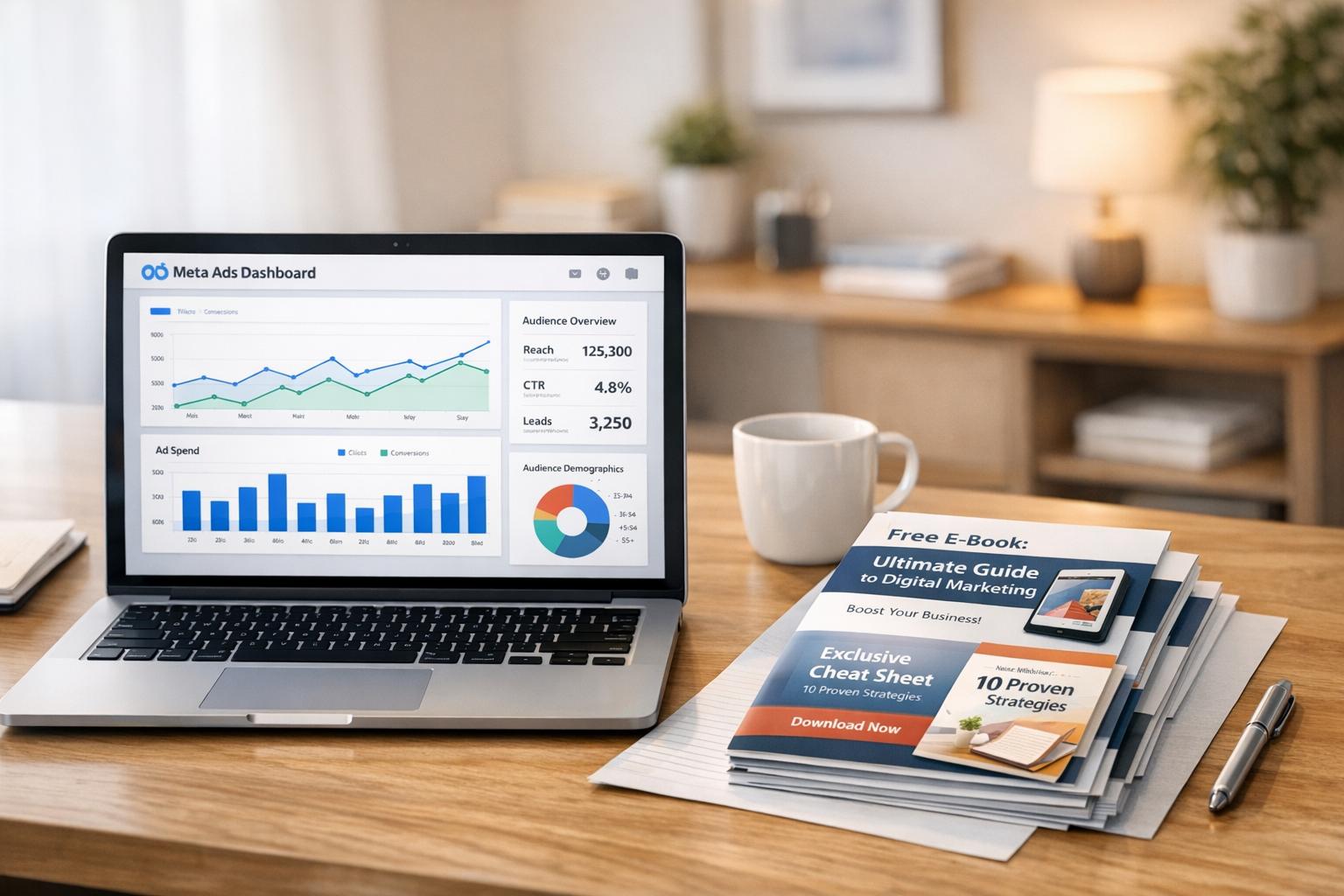
Lead magnets are free, valuable offers like eBooks, webinars, or discount codes that businesses use to collect contact information from potential customers. Meta Ads (Facebook, Instagram, Messenger) are a powerful way to promote these offers due to their massive reach, precise audience targeting, and user-friendly lead forms.
Here’s the key takeaway: Using Meta’s Lead Ads and targeting tools, you can streamline lead collection, improve conversion rates, and nurture relationships early in the sales funnel.
By following these steps, you can run effective campaigns that generate high-quality leads and set the foundation for long-term customer relationships.
When creating a lead magnet, focus on delivering a clear, actionable solution to a specific problem for a well-defined audience. The more targeted your offer, the better:
"Specificity is the most important element... Lead magnets should NEVER be vague." [8]
Instead of offering something overly broad, like a "Complete Guide to Retirement", try a more focused approach, such as a "5-Minute Calculator to Estimate Your Retirement Savings Gap." A lead magnet that can be consumed in under five minutes provides immediate value and avoids becoming a hurdle in your sales funnel. [8]
The best lead magnets solve problems quickly and efficiently. Here are a few formats that work well:
For example, in 2017, DigitalMarketer generated 35,859 leads in just 60 days with a lead magnet designed for quick consumption. As Ryan Deiss highlights:
"Your Lead Magnet must be consumed by the prospect for it to have an impact." [8]
If your audience downloads the lead magnet but never engages with it, the opportunity is wasted.
Your lead magnet should align with the stage of the funnel your audience is in. Each stage requires a different approach:
Here’s a breakdown of how lead magnets fit into each funnel stage:
| Funnel Stage | Goal | Recommended Lead Magnet |
|---|---|---|
| Top of Funnel | Awareness | Quizzes, Infographics, Video Training |
| Middle of Funnel | Trust/Education | Case Studies, Whitepapers, Webinars |
| Bottom of Funnel | Conversion | Discounts, Free Trials, Consultations |
Once you’ve mapped your lead magnets to the funnel stages, refine your targeting to ensure you’re reaching the right audience.
Meta’s robust targeting tools allow you to segment your audience into three main categories: cold, warm, and hot.
To save on ad spend, exclude existing leads from cold campaigns. If you’re getting low-quality leads, consider enabling Meta’s "Higher Intent" setting, which adds qualifying questions, such as "What’s your budget?" to filter for better prospects. [6]
Meta’s Advantage+ Audience tool is another game-changer. It treats your targeting inputs as suggestions rather than strict rules, allowing the algorithm to expand its reach based on conversion data, pixel history, and engagement patterns. As Jon Loomer explains:
"The beauty of Advantage+ Audience is that any targeting inputs are purely optional. If you don't provide an audience suggestion, Meta will prioritize things like conversion data, pixel history, and prior engagement." [12]
This AI-driven approach helps avoid the downsides of micro-targeting, such as fragmented audiences and higher ad costs. However, it’s crucial to ensure your creative content is strong enough to naturally attract the right audience.

Meta Ads Lead Magnet Campaign Setup: Complete Configuration Guide
Before you get started, make sure you have everything in place: a Facebook Page, an active ad account with valid payment details, and, if necessary, an Instagram account [14][16]. Don’t forget to install the Meta Pixel and Conversions API to track events accurately [13].
If you want to optimize for higher-quality leads, consider setting up a Meta CRM Dataset in Events Manager by linking your CRM data. This allows Meta to track which leads actually turn into sales, not just those who fill out the form. This approach works best if your business generates at least 200 leads per month and the conversion happens within 28 days of lead generation [19]. These steps are crucial for precise tracking and better campaign performance.
Accurate tracking is a cornerstone of successful campaigns. The Meta Pixel captures website activity, while the Conversions API sends server-side data [13]. For CRM integration, make sure to record each 15–17 digit Meta Lead ID [19]. You can sync leads using tools like Zapier or a custom API to enable quick follow-ups with potential customers [15][16].
When setting up your campaign, choose the Leads objective [13][17]. At the ad set level, you can either use Instant Forms, which pre-fill user data for convenience, or direct users to a website landing page for more design flexibility [1][4].
Your optimization goal matters just as much as the objective. If you want to focus on quantity, go for Lead Generation, which delivers a high volume of form completions at a low cost. If quality is your priority, use Conversion Leads, which leverages CRM data to target users more likely to convert into paying customers [15][17]. If you’re getting too many low-quality leads, enable the Higher Intent setting (is_optimized_for_quality), which adds a review step before users submit their information [17][1].
| Configuration Level | Key Settings for Lead Magnets |
|---|---|
| Campaign | Objective: Leads; Buying Type: Auction [13][17] |
| Ad Set | Conversion Location: Website or Instant Forms; Performance Goal: Conversion Leads [13][15] |
| Ad | Format: Single Image/Video or Carousel; Call to Action: Sign Up, Download, or Get Quote [17][18] |
| Tracking | Meta Pixel, Conversions API, and CRM Dataset [13][15] |
With your objectives set, organize your campaigns for maximum efficiency. Campaigns are typically structured into three levels: Campaign (objective), Ad Set (audience, budget, placements), and Ad (creative) [14][11]. You can allocate budgets using the Advantage Campaign Budget feature for automation or manage them manually with Ad Set Budgets [14][20].
To ensure stable performance, aim for your ad sets to hit approximately 50 optimization events within a 7-day period, which helps exit the "learning phase" [4]. Avoid audience overlap by consolidating ad sets and ensuring each has enough budget to meet this threshold. If you’re scaling a successful campaign, increase the budget gradually to maintain consistent results [4].
New campaigns automatically use Advantage+ settings, which streamline audience targeting, placements, and budget allocation [14][18][20]. Advantage+ Placements help identify the most efficient ad inventory across Facebook, Instagram, and the Audience Network [14][18][20]. For most campaigns, the Highest Volume bid strategy is the go-to option. However, advanced users can implement bid caps to control the maximum cost per lead, though this may limit ad delivery [20].
Your ad's visuals and text determine whether someone pauses to engage or keeps scrolling. Single image ads are ideal for straightforward offers like discounts or checklists because they deliver a clear and focused message [3]. Video ads, on the other hand, are perfect for explaining more complex ideas or sharing a story - especially since 64% of users watch videos on Facebook. These ads often generate more engagement than static images [2]. Then there are carousel ads, which let you showcase up to 10 swipeable cards. Each card can have its own headline and call-to-action, making this format great for multi-step guides or multi-part ebooks [4].
Always design with mobile users in mind. Use vertical formats like 4:5 for feed ads and 9:16 for Stories and Reels to maximize screen space [4]. For videos, include captions and high-contrast visuals to engage viewers who watch without sound [4]. These design choices are crucial for building a strong ad strategy.
When promoting lead magnets, choose the ad format that best aligns with your offer. Lead Ads with native forms simplify the process by allowing users to share their details without leaving the app. These forms even pre-fill fields using profile data, which can significantly boost conversion rates [2]. For example, in 2026, Optimizely used a Facebook Lead Ad to offer a free ebook. Users filled out a six-field native form in the News Feed to access the content [2].
Another option is Dynamic Creative, which tests different combinations of visuals and text to quickly identify what performs best [3]. This approach saves time and helps you scale successful ads more efficiently. If you're in a regulated industry, make sure your form fields and copy comply with Meta's Lead Ads policies to avoid any issues [2].
Once your visuals grab attention, your ad copy needs to close the deal. Keep the primary text under 125 characters to ensure it’s fully visible [21]. Focus on how your offer benefits the user rather than just listing features - explain how it solves a specific problem [4]. Use clear calls-to-action like "Download", "Sign Up", or "Learn More" that align with your campaign goals [4].
Tailor your message to your audience’s challenges. Personalization matters - 76% of customers are more likely to engage with a brand that speaks directly to their needs [4]. If you’re not attracting the right leads, consider adding qualifying questions to your form, like "What is your budget?" Alternatively, enable the Higher Intent setting to filter out less interested users [6].
| Placement Field | Recommended Character Limit |
|---|---|
| Primary Text | 125 characters [21] |
| Headline | 40 characters [21] |
| Description | 25 characters [21] |
"You can get far by making your marketing valuable and inviting." - Chris Savage, Founder and CEO, Wistia [10]
Refining your creative elements is key to generating high-quality leads. When testing ads, change only one variable at a time - like the headline or image - and run each test for at least 7 days. This ensures the algorithm has enough time to exit the learning phase [4]. Aim for 50 optimization events per variant during this period to achieve reliable results [4]. Use Advantage+ creative enhancements to add text overlays in your brand colors or provide multiple options for the primary text, headline, and description. Meta’s machine learning can then optimize delivery based on user preferences [21].
For example, in 2025, AdEspresso ran a two-week experiment, investing $1,050 per campaign to test audience targeting for lead magnets. They found that a "500+ Facebook Ad Examples" ebook performed far better when shown to a "Facebook Ads" blog reader audience compared to an "Instagram Ads" audience. The Facebook ebook achieved a cost-per-action of $1.26, while the Instagram ebook cost $1.97 per action [10]. This highlights how aligning your lead magnet with the right audience can boost performance and reduce costs.
Once your campaign is up and running, the next phase is all about fine-tuning and scaling for growth. This involves keeping a close eye on performance metrics, improving lead quality, and strategically scaling successful campaigns.
To gauge how well your campaigns are performing, focus on metrics like spend, impressions, leads, CPM (Cost per 1,000 impressions), CTR (Click-Through Rate), CPC (Cost per Click), and Cost per Result [4][23]. Additionally, tracking lead-to-sales conversion rates helps you determine which campaigns are actually contributing to revenue [3].
Here are a few benchmarks to aim for:
Jeff Sauer, founder of Data Driven, tested lead generation strategies by promoting a Facebook Ads study using "The Super Short" formula (under 30 words). This generated over 300 leads at a cost of $2.57 per lead. Similarly, Supermetrics applied the same approach for a webinar promotion, achieving a CPA of $2.79 [22].
| Metric | Purpose in Lead Magnet Campaigns |
|---|---|
| CPL / Cost per Result | Tracks the cost of acquiring one lead magnet sign-up. |
| CTR (Click-Through Rate) | Measures how appealing your ad and lead magnet offer are to the audience. |
| CPM | Monitors the cost of reaching your target audience. High CPMs may signal competition or narrow targeting. |
| Conversion Rate | Reflects the percentage of people who clicked the ad and completed the lead form. |
| Frequency | Tracks how often the same person sees your ad. High frequency can lead to creative fatigue. |
"This is where Supermetrics can be your best friend. I don't really like reporting, but you can build a report template you like. I created a template that shows which campaigns and creatives work best." - Jeff Sauer, Founder, Data Driven [22]
With these metrics in place, the next step is to focus on improving lead quality.
Generating a high volume of leads is great, but if they don’t convert, it’s a waste of resources. To filter out low-quality leads, consider adding qualifying questions to your Instant Forms. Questions about budget, timeline, or intent can help screen for serious prospects [4][3][9]. Multiple-choice questions work well as they increase the "barrier of interest" without making the form too cumbersome. For an extra layer of validation, enable SMS verification to weed out fake or inaccurate contact details [9].
Switching to the "Conversion Leads" performance goal can also help target users more likely to become customers rather than just filling out forms [23][7][9]. To make this work effectively, integrate your CRM with Meta using the Conversions API (CAPI). This syncs sales data back to Meta, helping the algorithm learn which leads are most likely to convert [23][7][9].
"Lead count does not correlate with lead quality. Often, a sales team is responsible for turning leads into actual sales." - Menachem Ani, Founder, JXT Group [3]
Ensure immediate follow-ups by syncing your CRM from the start. Automated email or SMS responses should be triggered as soon as someone submits their information since lead interest is highest right after submission [7][2]. If unqualified leads persist, try using the "Higher Intent" form type. This adds a review step where users confirm their details before submitting [9].
Scaling your campaigns requires a strategic balance between increasing reach and maintaining lead quality.
Keep an eye on your cost per 1,000 reach (CPMr) as an early indicator of audience fatigue. A healthy CPMr is generally under $20 [25]. If it spikes, it’s time to refresh your ad creative. Instead of small tweaks, introduce entirely new creative styles - like user-generated content or polished founder stories - to give Meta’s advanced algorithm more variety to work with [25].
"The brands that win are those that feed the system variety, not volume. Creative diversity and campaign simplicity are no longer best practices - they're survival tactics." - Anchour [25]
Simplifying your campaign structure can also improve performance. Consolidate overlapping ad sets to speed up optimization [25][4]. As you scale, set up a bi-directional CRM sync to ensure sales data flows back to Meta. This helps the algorithm focus on users likely to convert into customers, not just leads [4][26]. Custom audience list uploads on Meta typically achieve a match rate of 80% to 90% [26].
| Scaling Method | Action | Goal |
|---|---|---|
| Vertical | Increase budget by 20% every 3–4 days | Maximize ROI on a winning ad set [24] |
| Horizontal | Duplicate ad sets for 3–5% Lookalikes | Reach new but similar audiences [24] |
| Creative | Launch 5–10 radically different ad angles | Combat audience fatigue and lower CPMr [25] |
| Geographic | Target secondary markets (e.g., Canada, Europe) | Reduce costs by expanding to less competitive regions [24] |
"For lead generation campaigns… Make it easy for sales reps to mark new contacts qualified or unqualified. Then sync this value back into the Meta Ad Manager. This simple technique is proven to dramatically increase ongoing lead quality." - Jeremy Koenig, President, Giant Partners [26]
Promoting lead magnets with Meta Ads requires a thoughtful approach and careful execution. Start by creating lead magnets that directly address your audience's needs - whether it’s an eBook, a discount code, or access to an exclusive webinar[6].
Choose the "Leads" conversion objective and ensure proper tracking by setting up both the Meta Pixel and Conversions API (CAPI)[3][4][5][6].
Your campaign structure is just as important as your ad creative. Combine overlapping ad sets to move out of the learning phase, and refresh your creative regularly to avoid ad fatigue[4][27]. Keep instant forms simple by using pre-filled fields and limiting questions to only what’s essential[3][4]. Incorporate vertical videos (9:16 for Reels and Stories) and User-Generated Content (UGC) to build trust while staying cost-efficient[4][5].
Consistent optimization is key. Track metrics like Cost per Lead, CTR, and Frequency to spot when your creative needs updating[4][23]. Sync your CRM immediately to trigger automated follow-ups - timely responses are critical since lead interest tends to fade quickly after submission[5][6]. When scaling, increase budgets incrementally and introduce new creative angles to maintain performance.
One statistic to keep in mind: 76% of customers respond better to personalized messages[4]. Use real data to customize your approach and improve results.
By following these strategies, you’ll create a strong foundation for successful campaigns. If you need extra support, expert help can make all the difference.
Implementing these strategies effectively often requires professional expertise. That’s where Dancing Chicken comes in. They specialize in Meta Ads with a focus on lead generation and revenue growth. Their services include managing campaign structures, designing ad creatives, and engineering offers that drive ROI.
Plans start at $1,500/month for Growth, scaling up to $4,000/month for Enterprise. These packages include bi-weekly ad creative production, access to a real-time analytics dashboard, and 24/7 dedicated support via Slack.
Whether you need a full ad account audit, personalized strategies, or AI-powered lead qualification, Dancing Chicken’s data-driven approach ensures your campaigns deliver qualified leads that convert into revenue. Visit Dancing Chicken to explore how their expertise can help you scale profitably with Meta Ads.
Selecting the right lead magnet hinges on understanding where your prospect is in the funnel and how ready they are to engage. Tailoring your approach to each stage ensures you're meeting their needs and sparking interest effectively.
At the top of the funnel (TOF), aim for resources that are quick to digest and immediately helpful, like checklists, cheat sheets, or short ebooks. These should address a specific problem, pique curiosity, and be easy to access on mobile devices. The goal here is to grab attention with minimal effort from the prospect.
In the middle of the funnel (MOF), step it up with more detailed content such as webinars, case studies, templates, or mini-courses. These options not only demonstrate your expertise but also build trust while helping you gauge how willing your leads are to engage with deeper material.
When it comes to the bottom of the funnel (BOF), focus on high-value offerings like free trials, personalized audits, strategy sessions, or discounts. These lead magnets should directly address the prospect's decision-making process and highlight the advantages of your product or service, making the transition to the next step - like booking a call - feel natural and easy.
If you want to ensure your lead magnets are perfectly aligned with each funnel stage, teaming up with experts like Dancing Chicken can help you attract better leads and drive meaningful revenue growth.
Targeting the right audience is the cornerstone of a successful lead-magnet campaign with Meta Ads. Start by implementing the Meta Pixel and Conversion API to track user behavior and gather data for highly accurate targeting. Meta’s robust targeting options - such as demographics, interests, and behaviors - allow you to zero in on the most relevant prospects. Tools like Lookalike Audiences are especially helpful for discovering new users who resemble your top customers, while retargeting ensures you stay connected with people who’ve already engaged with your brand.
To take your campaign further, try Advantage+ Audience, which uses machine learning to fine-tune ad delivery based on your past campaign performance. Combine this with custom audiences - such as email subscribers or website visitors - and lookalike expansions to strike the right balance between reach and precision. Start with broad targeting to gather insights, then refine your approach using key metrics like click-through rate (CTR), cost-per-click (CPC), and return on ad spend (ROAS). By continuously analyzing and optimizing your strategy, you can ensure your ads connect with the most qualified U.S. audiences, driving high-quality leads efficiently.
To attract better leads using Meta Ads, prioritize AI-powered Advantage+ campaigns combined with eye-catching, mobile-friendly vertical creatives. Incorporate instant lead forms that are pre-filled for convenience, include SMS verification for accuracy, and use dynamic qualifying questions to identify the most relevant prospects.
Take targeting to the next level by utilizing privacy-compliant first-party data alongside contextual audience strategies. To maximize efficiency, link your lead forms directly to your CRM system for real-time follow-ups, ensuring every lead is promptly addressed and nurtured effectively.
When it comes to Meta ads, many brands don’t realize just how profitable the platform can actually be. Or even worse, an agency overpromised and underdelivered... leaving them frustrated with a fortune spent on ineffective campaigns.
Our clients see amazing results from Meta ads. That’s because we cover every angle—from targeted reach to dynamic creative testing to retargeting and more. With our full-funnel strategy and deep platform expertise, we make sure your Meta ads drive maximum profitability, every step of the way.
%20(1).png)
.svg)
